

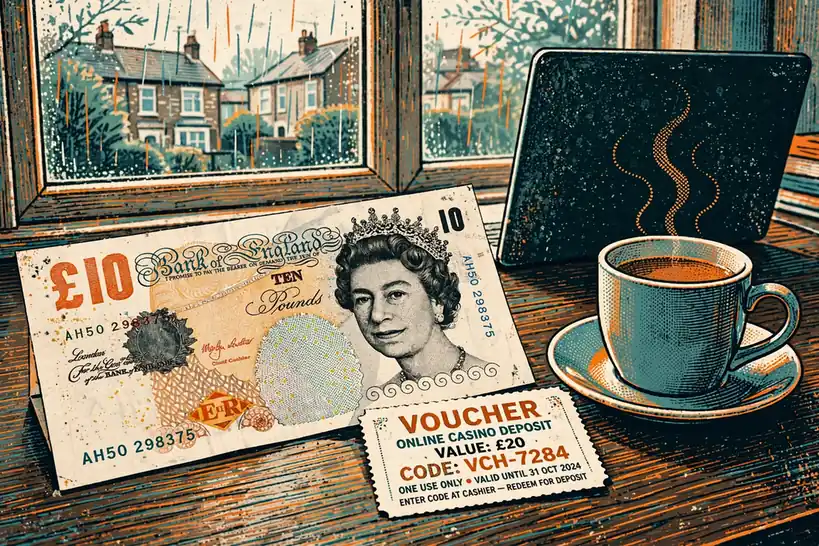
CashToCode availability can vary by casino, account and location, so confirm the cashier listing and payment terms before choosing a method.
CashToCode Availability at UK Casinos in 2026
CashToCode acceptance at British online casinos requires careful qualification. The payment brand may appear in searches for casino deposits, but its presence in a general payment discussion does not establish that a particular remote gambling licensee currently accepts it. Availability can depend on the casino, the customer’s location, the account currency and the payment options enabled for that account.
A casino described elsewhere as accepting CashToCode should therefore not automatically be treated as a confirmed option for British customers in 2026. Payment arrangements change, and a method can be removed, restricted or displayed only to selected account holders. The relevant indication is the payment cashier attached to the individual casino account, together with the operator’s own terms for deposits and withdrawals.
What “accepts CashToCode” needs to mean
The phrase can refer to several different situations:
- CashToCode may be displayed as a deposit method.
- The method may be available only after account registration or verification.
- CashToCode may be offered by a payment intermediary rather than directly by the casino.
- A casino may accept a CashToCode deposit while applying separate conditions to any withdrawal.
- The payment option may appear in material aimed at another country but not in a British account.
These distinctions matter because a deposit button alone does not establish full payment compatibility. A method must be considered in relation to the transaction being made. If the purpose is to fund casino play, the deposit facility is the immediate issue. If the purpose also includes receiving winnings, the withdrawal position must be established separately rather than inferred from the deposit screen.
The wording “all CashToCode casinos in the UK” is consequently too broad to describe a stable directory without current operator-level confirmation. The same applies to labels such as “best CashToCode casinos”, “new CashToCode casinos” or “CashToCode casinos with bonuses”. Acceptance of a payment method does not, by itself, demonstrate that an operator has the most suitable games, promotion terms or account conditions. Those are separate questions.
Why availability can differ between accounts
Online casino cashiers are not necessarily identical for every customer. The payment methods displayed can be affected by jurisdiction, currency, account status and the operator’s payment arrangements. A British account may therefore show a different selection from an account created elsewhere. A method mentioned on a third-party page may also refer to an earlier configuration.
Payment information published in a specialist review should be treated as time-sensitive rather than as proof of present availability. This is particularly important where the wording describes a casino’s payment portfolio in general terms but does not identify the current cashier for a British account. A historical reference can explain why CashToCode is associated with a casino, but it cannot establish that the option remains active.
Casinos That Accept Citadel in the UK · Casinos That Accept iDEAL in the UK: What to Check
The same caution applies to Android casino searches. Android is a device platform, not a payment authorisation. A casino that can be opened on an Android phone is not thereby a CashToCode casino, and a payment method visible on a desktop site may not be shown in a mobile interface. Access to the casino and compatibility with CashToCode are separate characteristics.
British regulatory context
For customers in Great Britain, real-money remote gambling is offered by operators holding the relevant Gambling Commission licence. The licensing position and the payment position are related only in a limited sense: a current licence concerns the legality and regulatory status of the operator, while CashToCode acceptance concerns the payment facilities made available through its cashier. One cannot be used as evidence of the other.
Age verification is required before a customer can deposit funds into a gambling account. Payment activity may also be subject to account checks and ownership controls. The name and account information used for a payment should correspond to the customer’s casino account, since inconsistencies can create avoidable transaction friction. These controls do not show that CashToCode is supported; they describe conditions surrounding regulated casino accounts.
Credit-card payments for gambling are not permitted at UK-licensed casinos. This restriction also covers credit-card funding routed through a money service business, and operators cannot accept wallet payments where the wallet permits credit-card funds to be used for gambling. Consequently, any description of a CashToCode route must not be interpreted as a way around those restrictions.
UK Restrictions
Credit-card payments for gambling are not permitted at UK-licensed casinos. This includes credit-card funding routed through a money service business.
Interpreting casino payment pages
A payment page may list well-known brands such as Visa or Mastercard, but that listing is not sufficient evidence that every card product is eligible or currently available to British customers. A specialist review can report that those brands appear among a casino’s payment methods, while the active cashier determines what can actually be used for the account in question.
CashToCode should be assessed by the same standard. The meaningful distinction is between a current, account-specific cashier entry and a general statement repeated across casino pages. Where the cashier identifies CashToCode for deposits, that establishes a deposit route at that point in time. It does not establish withdrawal support, promotional eligibility or continuing availability after the account’s circumstances change.
Accordingly, the most accurate description of CashToCode casinos in the United Kingdom in 2026 is conditional rather than categorical. Some casino accounts may display the method, while others may not. A casino’s reputation, mobile accessibility, game catalogue or promotional wording cannot substitute for a current payment entry. Availability is a property of the particular account and transaction, not a permanent feature that can safely be assumed from a name appearing in a general list.
Top online casinos in the UK
- BeOnBetBonus: 100% up to €500 + 100 FS · Payout speed: 1-3 business days
- SlotoSportBonus: 500% up to £ 10 200+ 777 FS · Payout speed: 1-3 business days
- EvoSpinBonus: 125% up to €2500 + 125 Free Spins · Payout speed: 1-3 business days
- NightWinBonus: £900 + 400 free spins · Payout speed: 1-3 business days
- Revery PlayBonus: 100% up to€1,000+ 100 FS · Payout speed: 1-3 business days
- WinBeastBonus: €5000 + 500 FS + €650 Freebet · Payout speed: 1-3 business days
- AmunbetBonus: Join now and get 450% up to 2,700 GBP + 450 FS · Payout speed: 1-3 business days
Payment Methods That Can Replace CashToCode
When CashToCode is not displayed in a UK casino cashier, the available substitutes generally fall into two groups: methods intended for both directions of a transaction and routes that are limited to funding an account. That distinction matters because a deposit option does not automatically provide a way to receive winnings. The cashier’s withdrawal menu and the casino’s payment terms determine whether a method supports both functions.
Casino Payments: Compare UK Deposit and Withdrawal Options
Debit cards
Debit cards are among the established alternatives at UK casinos. Visa and Mastercard debit cards are commonly accepted, subject to the individual operator’s cashier and the card product involved. They can therefore be considered where a direct card deposit is preferred over a voucher-based route.
The relevant option is a debit card, not a credit card. UK-licensed casinos cannot accept credit-card payments for gambling, including credit-card funding routed through a money service business. Wallets that allow credit-card funds to be used for gambling are also excluded under the same regulatory framework. A card that appears suitable for ordinary online payments may therefore still be unsuitable for gambling deposits if its funding source or product type falls within those restrictions.
Debit cards may not offer the same transaction path in both directions. A casino can display a card deposit option while directing withdrawals through another method or applying its own return-of-funds procedure. The presence of Visa or Mastercard branding is consequently not enough to establish withdrawal compatibility.
Open banking and bank transfers
Open banking and bank transfers are another possible replacement. A specialist review has described these routes as capable of supporting instant deposits and fast withdrawals at many sites, but the feature is not universal and depends on the operator, bank connection and cashier configuration. They are more relevant than a deposit-only voucher where the same broad banking route is intended to handle both funding and payouts.
Bank-based methods can also involve account ownership checks. The casino may need the banking details to correspond with the registered account holder, and a transaction can require additional review if the ownership information does not align. This is separate from the question of whether the banking method is technically shown in the cashier.
Debit Cards
Visa and Mastercard debit cards are commonly accepted, subject to the operator’s cashier and the specific card product.
Open Banking
Supports instant deposits and fast withdrawals at many sites, depending on the operator and bank connection.
E-wallets
Skrill and Neteller are available at some sites, though they may be excluded from certain promotional eligibility.
Prepaid Vouchers
Paysafecard is a deposit-only instrument and does not provide a withdrawal channel for winnings.
Open banking should not be treated as a single universal product. Different services connect to different banks, and the available route can change between casinos. A bank transfer may likewise be presented as a separate cashier option rather than as an open-banking payment. The practical distinction is whether the method is listed for the required transaction direction and whether the account details can be verified.
E-wallets
Skrill and Neteller are available at some UK-facing casino sites. A specialist review has also reported that these wallets are often left outside promotional eligibility, so their availability for deposits should not be confused with qualification for a welcome offer or another promotion. The promotional position is an account-term issue rather than evidence that the wallet is unavailable.
E-wallets can be useful where a casino supports them for both deposits and withdrawals, but that capability must be established separately for each operator. Some cashier systems may display a wallet prominently for deposits while applying different conditions to withdrawals. The wallet account should also belong to the same customer as the casino account. Consistent ownership information reduces avoidable questions about the source and destination of funds.
Wallet funding must comply with the prohibition on credit-card gambling. If a wallet permits credit-card funds to be used for gambling, the payment route cannot be treated as an acceptable workaround. A wallet balance funded through an eligible source is a different matter, but the casino’s payment rules remain decisive.
Casinos That Accept Maestro in the UK: What to Check · Casinos That Accept Monzo in the UK: Payment Guide
Prepaid vouchers
Paysafecard provides a clear alternative for players seeking a prepaid deposit method rather than a bank or wallet route. Its role is limited: it is a deposit-only instrument and does not provide a withdrawal channel for casino winnings. A separate payout method is therefore required when this option is used.
That limitation makes Paysafecard structurally different from a bank transfer, an eligible debit card or an e-wallet that the casino supports in both directions. It may still serve the immediate purpose of adding funds, but it should not be described as a complete replacement where the requirement includes receiving withdrawals through the same method.
Less widely listed options
Jeton is another payment name that may appear in this context. A specialist review indicates that, in 2026, its presence is confined to a small number of UK online casinos rather than being a broadly available cashier standard. Its inclusion should therefore be treated as site-specific and current rather than assumed across the market.
The same caution applies to any alternative not visible in the cashier. Availability can differ by jurisdiction, account, currency and transaction direction. A method may exist in a casino’s general payment information yet be unavailable after login, or it may be offered for deposits without being enabled for withdrawals.
The alternatives are therefore not interchangeable. Debit cards, open banking, bank transfers and selected e-wallets may support a wider transaction relationship, while Paysafecard is deposit-only and Jeton has comparatively limited reported availability. Where a method involves a wallet or bank account, the ownership details should correspond to the casino account, and where it is used for gambling, its funding source must comply with the UK prohibition on credit-card payments.
Payment Summary
- Availability is property of the particular account and transaction, not a permanent feature.
- A deposit method does not automatically guarantee withdrawal support.
- Ownership details for payment methods should correspond to the casino account to avoid friction.
- UK-licensed casinos must comply with specific rules regarding spin duration, autoplay, and stake limits.
Checking Whether a Casino Accepts a Payment Method
Payment availability is determined by the casino cashier, not by a general list of methods associated with online gambling. The cashier is the part of the account where the operator displays the routes currently enabled for that customer, account currency and transaction type. This matters when checking whether CashToCode remains accepted, whether a CashToCode-linked card is recognised, or whether a different payment service is available instead.
A payment brand may appear in an operator’s general terms, help material or promotional page while being absent from the cashier. Conversely, an option may be shown only after the account has passed the relevant checks or after a particular transaction screen has been opened. Availability can therefore vary between operators and between accounts. The practical test is to sign in, open the deposit area and inspect the methods presented there rather than relying on a static third-party list.
Deposit acceptance is not withdrawal acceptance
The presence of a method in the deposit section establishes only that the casino is offering it for funding the account. It does not establish that the same route can receive a withdrawal. Some payment services are deposit-only, while other methods may be available for both directions under the operator’s closed-loop rules and anti-money-laundering procedures.
Casinos That Accept UKash in the UK: Payment Status · Casinos That Accept MuchBetter in the UK
The withdrawal screen should therefore be checked separately. A method that accepts a deposit may disappear when a payout is requested, or the casino may direct the funds back to the original payment source. UK anti-money-laundering controls commonly require withdrawals to return to that source, although an alternative route may be requested if the original method cannot receive funds. Such a change can involve additional verification.
This distinction is especially important for CashToCode searches that combine deposit acceptance with claims about real-money play, free spins or no-deposit offers. Payment compatibility does not establish bonus eligibility, and it does not show that a payment route can be used to collect winnings. Those are separate account and promotion conditions.
Information to compare in the cashier
A useful check records more than the payment logo. The relevant details include:
- whether the method appears under deposits;
- whether it is also listed under withdrawals;
- the account currency supported by the method;
- any identity or ownership checks requested before use;
- whether the operator labels the route as deposit-only;
- whether the displayed terms apply to the specific account.
The account holder’s information should correspond with the details attached to the payment route. Using account information and a payment route belonging to the same customer reduces the possibility that basic ownership discrepancies create avoidable friction during a transaction. The cleanest arrangement is often one named account used consistently for both depositing and withdrawing.
A card or wallet label alone does not resolve every compatibility question. The particular product, issuer, account status and transaction direction may affect what the cashier permits. This is why searches for casinos accepting CashToCode debit cards cannot substitute for an account-level check, and why a casino that once displayed a method should not be assumed to offer it indefinitely.
A cautious verification sequence
The process can remain straightforward:
- Confirm that the casino serves the relevant UK market and holds a current UK Gambling Commission operating licence.
- Complete the account details and age checks required before depositing.
- Open the cashier and record the methods shown for deposits.
- Open the withdrawal area separately and check whether the same method is available there.
- Read the payment terms concerning ownership, closed-loop processing and verification.
- Confirm the account currency before initiating a transaction.
This approach separates what the operator currently enables from what older pages, review material or promotional wording may suggest. It also prevents a deposit option from being mistaken for a complete payment route when the intended transaction is a withdrawal.
Mobile Slots and Payment Compatibility
Mobile access does not establish payment compatibility. A casino may provide a responsive website or mobile application for slot play while displaying a different selection of payment methods in its cashier. Consequently, the fact that slots load on a smartphone does not show that CashToCode can be used to fund the account.
The relevant distinction is between the gaming interface and the cashier. The mobile site controls access to the casino games; the cashier records which payment services are available for the account, currency, jurisdiction and selected transaction type. A service identified in general casino material may therefore be absent when the account is opened or when a deposit is initiated.
Mobile vs Cashier
The mobile site controls access to the casino games, while the cashier records which payment services are available for the specific account and currency.
Searches for CashToCode mobile slots in the United Kingdom can consequently produce an ambiguous result. They may refer to casinos whose websites are mobile-compatible, to a payment service discussed in general terms, or to slot play at sites where the method is not actually presented to a particular customer. None of those descriptions demonstrates that online slots can be funded by CashToCode.
The same caution applies to references to real-money slots using CashToCode. Real-money access depends on the casino account being permitted to accept deposits through the selected route, whereas mobile compatibility concerns the device and website. These are separate technical and account-level conditions. A payment brand shown on a desktop page may also be unavailable in the mobile cashier, while a method offered through the mobile interface may have conditions that differ from those described elsewhere on the site.
Card references require particular care in the British market. A specialist review may list Visa and Mastercard among the payment brands associated with casinos, but the current availability of a card product and its eligibility for a particular gambling transaction must be checked in the casino cashier. The appearance of a card logo is therefore not sufficient evidence that every Visa or Mastercard product can be used.
That point does not turn CashToCode into a confirmed mobile payment option. It establishes only how payment claims should be assessed alongside mobile access: the cashier, rather than the game lobby or a general payment banner, determines whether the relevant method is presented for the account.
Free slot access also does not resolve the issue. A free-play mode can be available without any deposit method being supported, because it does not test the casino’s acceptance of a funding route. Conversely, access to a slot in demo mode does not show that the same casino accepts CashToCode for paid play.
The most reliable description is therefore limited: mobile slots and payment compatibility must be treated as separate questions. A mobile-friendly casino may offer slot access without CashToCode, and a listed payment service cannot be assumed to work merely because the games are accessible on a phone.
Do
- Confirm the casino holds a current UK Gambling Commission licence.
- Verify the cashier for both deposit and withdrawal availability.
- Ensure payment account details match your casino account.
Don’t
- Assume a deposit method can be used to withdraw winnings.
- Rely on third-party lists instead of checking the live cashier.
- Use credit cards for gambling deposits at UK-licensed sites.
Real-Money Slot Play and Payment Rules
Real-money slot play at a UK casino is governed by rules that concern the game itself as well as the payment route used to fund the account. A payment label, including CashToCode where it appears in a cashier, does not alter the operating requirements applied to online slots. The relevant question is therefore not only whether funds can be deposited, but also whether the gambling account and the game comply with British requirements.
Remote gambling operators must verify a customer’s age before allowing money to be deposited into a gambling account. This requirement applies before real-money slot play begins. Account details and payment information should also correspond to the same customer. Consistent ownership information reduces avoidable friction when a casino checks the source and destination of funds, although it does not remove the operator’s KYC obligations.
A payment method cannot be treated as evidence that a particular slot accepts that method directly. The casino normally receives the deposit into the gambling account, after which the balance can be used for the games made available on that account. Consequently, searches for slots that accept CashToCode, CashToCode slot machines or real-money games using CashToCode can obscure the actual arrangement. Compatibility is generally a cashier and account matter, while the slot is played from the casino balance. Any availability still depends on what the relevant remote gambling licensee makes available.
The rules governing the pace of play are particularly important. Online slot spins in Britain must last at least 2.5 seconds. This applies to each spin and is intended to prevent excessively rapid play. A game may therefore display a result quickly while still being subject to the required minimum cycle duration before another spin can begin.
Casinos That Accept AstroPay in the UK
Autoplay is banned for online slots in Britain. A player must initiate each spin rather than setting the game to continue without an individual command. This restriction remains relevant regardless of whether the account was funded by a debit card, bank transfer, electronic wallet, prepaid voucher or another payment route accepted by the casino. It also means that an app or mobile interface cannot lawfully bypass the rule by presenting continuous automated play.
The maximum stake per game cycle is £5 for customers aged 25 and over. For customers aged 18 to 24, the maximum is £2. The £5 limit for all adults came into effect on 9 April 2025. These limits apply to online slots and are separate from deposit limits or payment-provider restrictions. A cashier may permit a transaction while the game remains subject to its own stake controls.
Accordingly, real-money play with a payment method such as CashToCode is not a route around age checks, stake limits, minimum spin duration or the prohibition on autoplay. The payment system supplies a funding route where accepted; the casino’s account controls and the applicable British slot rules determine how the balance may be used.
Deposits, Withdrawals and Payment Timing
A deposit and a withdrawal follow different processing paths. Funds added to a casino account may appear quickly once the payment provider authorises the transaction. A payout, by contrast, normally requires the casino to review the request before money leaves the account. This distinction matters when assessing CashToCode casino payments in the UK: the presence of a deposit route does not by itself establish a direct withdrawal route.
Verification Sequence
Step 1: Licence Check
Confirm that the casino serves the UK market and holds a current UK Gambling Commission licence.
Step 2: Account Setup
Complete the necessary account details and age verification checks.
Step 3: Deposit Inspection
Open the cashier and record the methods specifically shown for deposits.
Step 4: Withdrawal Inspection
Open the withdrawal area separately to see if the same method is available for payouts.
Step 5: Terms Review
Read the payment terms regarding ownership, closed-loop processing, and verification.
UK anti-money-laundering controls generally require winnings to be returned to the payment source used for the deposit. Consequently, a CashToCode transaction may not function as a straightforward cash-out method even where it is available for funding an account. The available withdrawal route can depend on the casino’s closed-loop rules, the payment provider and whether the original source can receive payouts.
Withdrawal timing therefore includes more than the transfer itself. The casino may first approve the request, review account information and complete KYC checks. A specialist review identifies internal approval and account verification as factors that can make first withdrawals take longer than later requests. This is a processing explanation, not a fixed timetable: the relevant cashier and withdrawal terms determine the applicable stages.
Some routes are associated with quicker withdrawals, but this remains dependent on the casino’s systems. A specialist review places PayPal, open banking services and debit cards connected to fast payout systems among the faster options. That observation should not be transferred automatically to CashToCode. A CashToCode deposit can be recorded promptly while the payout is directed through another supported method, delayed for approval or unavailable until ownership checks are complete.
The account holder’s details and payment credentials also matter. Using a payment route belonging to the same customer reduces avoidable ownership questions during transaction processing. Where a casino requests further evidence, the payout can remain pending until the requested information has been assessed. A first withdrawal may therefore take longer than a later one even when the deposit appeared immediately.
For practical comparison, transaction speed has at least two separate components:
- Deposit processing: authorisation by the payment provider and crediting of the casino balance.
- Withdrawal processing: casino approval, any KYC review and delivery through an eligible payout channel.
This separation explains why searches for instant banking, fast debit-card withdrawals or direct CashToCode withdrawals can produce different answers. The relevant question is not only whether CashToCode can fund a casino account, but also which withdrawal channel the operator permits after the deposit has been accepted.
Bonus Eligibility and Payment Methods
A payment method can affect whether a casino promotion applies, even when the method is available for funding an account. Deposit availability and bonus eligibility are separate conditions. A cashier may accept a particular route while the promotion rules exclude deposits made through it from contributing to a welcome offer, free spins or another incentive.
PayPal illustrates why the distinction matters. A specialist review reports that PayPal is valued for speed and convenience but may be excluded from bonus eligibility. That observation should not be treated as a permanent rule across British remote gambling licensees: promotional terms can change, and the relevant conditions belong to the specific offer. A PayPal deposit may therefore be accepted without producing the qualifying status expected from a card or another listed route.
Bonus Eligibility
Attention A deposit method being available in the cashier does not guarantee it is eligible for welcome offers, free spins, or other promotions.
The same qualification applies to Skrill and Neteller. They are available at some sites, while a specialist review reports that deposits made through these e-wallets are often excluded from promotions. “Often” in that report describes the reviewed material, not a universal condition for every casino or every campaign. The offer’s payment-method clause remains decisive.
CashToCode-specific claims require particular restraint. Availability of CashToCode at a casino would not, by itself, establish entitlement to a welcome bonus, a slot promotion, free spins or a bonus code. No general CashToCode promotion can be inferred from the payment brand alone. A casino might accept the method but exclude it from a particular campaign, or apply separate terms to voucher-funded deposits. The promotion page and its full terms would need to identify the qualifying payment routes.
Several details can alter the outcome:
- whether the offer is limited to selected deposit methods;
- whether a payment route is excluded from bonus qualification;
- whether the deposit must be made during the stated promotional period;
- whether the promotion has separate conditions for casino games or slots;
- whether a bonus code must be entered when the offer is claimed.
A deposit that fails the promotion’s payment condition may still fund the gambling account; it simply may not activate the associated incentive. The bonus balance, free-spin entitlement and any related terms should therefore be considered separately from the question of whether CashToCode appears as an available cashier option. This separation is especially important when assessing real-money slot promotions, because payment compatibility alone says nothing about promotional eligibility.
Minimum Deposits, Limits and Financial Controls
Minimum deposits are not fixed across UK casinos or payment methods. A specialist review gives a common starting range of £10–£20, but this should be treated as an indication rather than a standing rule. The cashier may apply a different threshold to a particular payment route, including any CashToCode option shown there. A £5 deposit should therefore not be assumed to work merely because the payment method is available.
The displayed minimum is only one part of the account’s financial framework. Casinos may set maximum deposit amounts for each transaction, while separate daily or monthly ceilings can also apply. These limits are influenced by the payment method and by the account’s status. A newly opened or incompletely checked account may therefore have different boundaries from an established account, and the same method may not show identical limits for every customer.
Account controls also have a regulatory role. Before a new customer makes a first deposit, a remote operator must require a financial limit to be set. That requirement is separate from the payment method’s own minimum and maximum values: it concerns how much can be deposited or spent under the account’s control settings. The casino must also make those controls accessible after registration, so that account-level limits can be reviewed and managed without relying solely on payment-provider settings.
Casinos That Accept eCheck in the UK: Payment Guide
This distinction matters when assessing CashToCode casinos in the UK. A payment route may appear in the cashier while the account still prevents a transaction because the chosen amount exceeds a casino limit, conflicts with a financial control, or falls below the method’s minimum. Conversely, a payment method’s advertised threshold does not reveal the personal limit assigned to an account.
The practical position is therefore determined by three separate entries: the minimum accepted by the selected payment method, the casino’s transaction and account ceilings, and the customer’s own financial-control settings. These values should be read in the cashier before a deposit is attempted, rather than inferred from the presence of a CashToCode logo or from a general description of the casino.
Comparing Alternative Payment Costs
A CashToCode replacement cannot be identified as the cheapest option in every transaction. The final cost depends on the casino, the payment provider, the account currency and the amount being moved. A route with no separately displayed charge may still involve costs elsewhere in the payment chain.
A cost comparison should account for several possible components:
- a fee charged by the casino;
- a payment-provider charge;
- an issuer or bank fee;
- the exchange-rate spread applied during conversion;
- a network fee, where the payment route uses one.
These components do not necessarily appear in one place. The casino cashier may show its own charge, while the provider or bank applies a separate amount. The account terms and the payment service’s pricing information therefore need to be considered together rather than treating the cashier display as the complete price.
Currency is particularly important. An account held in pounds sterling can avoid some conversion, but the supported account currency should be confirmed before the first transaction. If funds pass between currencies, the exchange rate used by the provider, bank or card issuer becomes part of the cost. A visible flat fee is not the only measure: a conversion spread can exceed that fee, according to a specialist review, depending on the currencies and amount involved.
The amount transferred also affects the comparison. A fixed charge has a different effect on a small transaction than on a larger one, while a percentage-based or exchange-related cost changes with the value being converted. Network charges may also vary according to the payment route and its underlying infrastructure.
Casinos That Accept E-Cheques in the UK
The practical comparison is therefore between the total cost for the intended amount, not between method labels. A debit card, bank transfer, e-wallet or prepaid route may each have different charges at different casinos and may be priced differently by the associated provider. The absence of a casino fee does not establish that the whole transaction is free.
For that reason, the best alternative to CashToCode on cost grounds depends on the specific cashier, currency and transaction value. The relevant terms should be checked before confirming a deposit, with attention to both the displayed charge and any conversion rate or external fee that may apply.
CashToCode, GamStop and UK Casino Safeguards
CashToCode availability does not establish whether a casino is connected to GamStop. These are separate matters: one concerns a payment route, while the other concerns participation in a national self-exclusion scheme. A casino may display a payment option without that display proving anything about its GamStop status, licensing position or responsible-gambling controls.
Casinos That Accept Bitcoin in the UK: What to Check
For British customers, the relevant distinction is between remote gambling licensees operating under the UK Gambling Commission framework and offshore casinos outside that system. Remote gambling licensees selling into Great Britain must hold the appropriate UK Gambling Commission licence. Payment branding cannot replace that regulatory requirement, and the presence of CashToCode cannot be treated as evidence that a site is authorised for the British market.
At a UK-licensed casino, safeguards apply independently of the selected deposit method. Before allowing a new customer to make a first deposit, the operator must prompt the customer to set a financial limit. Account-level controls must also remain accessible, so that financial restrictions can be reviewed and managed within the account. These obligations are not removed by choosing CashToCode, a bank route, a card or an e-wallet.
GamStop status also should not be inferred from promotional wording such as “not on GamStop”. An offshore casino may be accessible to British residents without holding a UK Gambling Commission licence, but it does not operate within the UKGC regulatory system. That distinction matters because UK-licensed casinos must provide responsible-gambling tools, including self-exclusion, and must offer an internal complaints process together with access to an approved Alternative Dispute Resolution service. They are also required to contribute to the Research, Education and Treatment levy.
The practical result is narrow but important: a search for casinos accepting CashToCode cannot, by itself, identify sites outside GamStop or establish that a particular operator offers suitable safeguards. Licence status and account protections are separate checks. Before depositing, the operator’s licence number should be checked on the UK Gambling Commission’s public register, while CashToCode availability should be treated only as a cashier feature, not as evidence of GamStop status.
What is the fastest withdrawal method for UK casinos?
PayPal, open banking and debit cards linked to fast payout systems are generally among the quickest options. The time also depends on the casino’s approval process and whether your account is fully verified.
What are the deposit limits at HunnyPlay Casino?
UK casino deposit limits vary by payment method and account status. New customers must be prompted to set a financial limit before their first deposit, and account-level limit controls must be available.
Can I deposit in GBP?
Yes, GBP is supported. Confirm that your account is set to GBP before depositing to avoid currency conversion.
Which method has the lowest fees?
There is no universally lowest-fee method. Compare casino and provider charges, currency conversion spreads, and any bank or network fees for the payment and amount you plan to use.
Are Visa and Mastercard deposits definitely debit cards?
No. Visa or Mastercard being listed does not confirm that every card product is eligible; check the cashier for the card options available to your account. Credit cards cannot be used for gambling at UK-licensed casinos.
Which payment methods are listed for 333 Casino?
The listed methods include Visa, Mastercard, bank transfer, e-wallets and several cryptocurrencies. Check the casino cashier for current availability in the UK.