

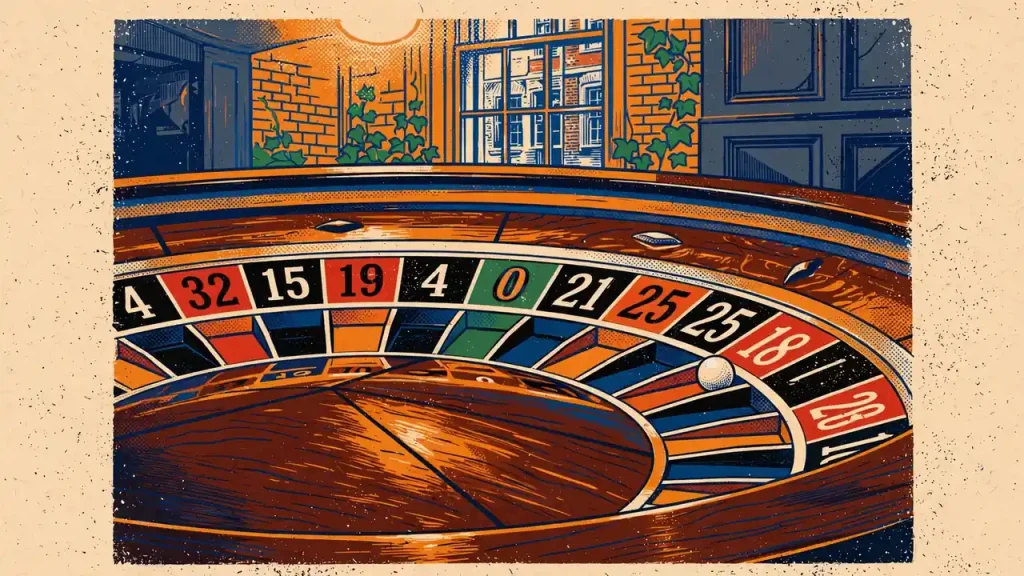
See how the 37-pocket wheel, betting layout and game format affect roulette play, and what to check in UK casino terms.
How European Roulette Works
European roulette is built around a wheel with 37 pockets: the numbers from 1 to 36 and one green zero. The ball is released around the rim and eventually drops into one of these pockets. Each spin is an independent event, so the result of an earlier round does not alter the mathematical chance of a later one.
The single zero is the defining feature of this format. Thirty-six pockets carry numbered values, while the remaining pocket carries zero. The numbered pockets are coloured red or black, with the zero kept separate from both colours. This arrangement supports the familiar even-money wagers, but it also creates the casino’s mathematical advantage: the zero does not belong to red or black, odd or even, or the usual high and low groups.
Why the zero matters
A European roulette casino may display a layout with many betting areas, but the wheel determines the underlying probability. A wager on red, for instance, covers the 18 red numbers. Black covers the 18 black numbers. The single zero is outside both groups. The same principle applies to even and odd, and to the high and low number ranges.
If all 37 pockets were treated as equally favourable to the player, an even-money bet would return the original stake plus an equal profit whenever one of its 18 numbers appeared. The zero prevents that balance. It is a losing result for these conventional outside bets, while the casino retains the built-in advantage created by the extra pocket.
For standard European roulette, the house edge is 2.70%. This figure describes the long-term mathematical advantage of the casino rather than the outcome of any individual spin. A player can win a particular round, and a sequence of wins can occur, but neither event changes the underlying expectation across a sufficiently large number of spins.
Casino Games: Slots, Table Games and Live Casino
The edge is embedded in the relationship between the wheel and the payout rules. It is not caused by a dealer’s action, the speed of the game or the pattern of previous results. A number that has not appeared recently is not made more likely by its absence, and a number that has appeared repeatedly is not made less likely merely because of that sequence. The wheel does not compensate for earlier outcomes.
La Partage and even-money bets
Some European roulette tables apply La Partage to eligible even-money wagers. Under this rule, when the ball lands on zero, half of the stake on an even-money bet is returned rather than being lost in full. The rule therefore changes the effect of zero for those specific wagers.
La Partage reduces the house edge on even-money bets to 1.35%. It does not turn the bet into a fair proposition, and it does not alter the wheel’s 37-pocket structure. The reduction comes from the partial refund applied when zero appears. Other types of wagers are not covered by this explanation of La Partage, so the rule should not be treated as a general reduction applying to every bet on the table.
The distinction matters when comparing a European roulette casino UK offering with another table using the same wheel. Two games can both have a single zero while presenting different rules for what happens when that zero appears. The wheel structure remains the starting point, but the applicable table rules determine how a particular wager is settled.
What a spin can and cannot show
A spin produces one pocket, not a prediction about future spins. The presence of 37 possible pockets means that the next result cannot be inferred from a recent run of red, black, high, low, odd or even outcomes. Betting records may describe what has happened, but they do not alter the probabilities governing the next ball drop.
This is the essential framework for online European roulette: a single-zero wheel, independent random outcomes and a house edge established by the relationship between the number of pockets and the payouts. La Partage can lower that edge for qualifying even-money wagers, but it does not remove chance from the game or provide a method for forecasting the winning pocket.
Wheel Structure 37 pockets (1-36 and one green zero)
House Edge 2.70% for standard European roulette
Main Variants RNG, Live Dealer, and Speed roulette
Market Regulation UK Gambling Commission (UKGC)
European Roulette Bets and Payouts
European roulette offers two broad categories of wagers: inside bets, placed on specific numbers or small groups on the layout, and outside bets, covering larger groups with lower payouts. Understanding this distinction is central to deciding how to play European roulette online, whether the table is an RNG game, a live dealer table or a VIP roulette room. The payout describes the profit from a winning wager; the original stake is returned separately.
Inside bets
Inside bets target individual numbers or compact combinations. They produce larger returns because the selected outcome represents a smaller part of the wheel.
A straight-up bet is placed on one number, including zero. If that number wins, the payout is 35:1. This means a winning stake produces thirty-five units of profit, while the original stake is also returned. The same straight-up payout applies in European and American roulette, although the two variants have different pocket structures.
A split bet covers two adjacent numbers. It pays 17:1 when either selected number appears. The wager is positioned across the shared boundary between those numbers, so the relationship between the chosen numbers on the layout matters.
A street bet covers a horizontal row of three numbers and pays 11:1 if one of those numbers wins. It therefore occupies a middle position between a single-number wager and broader outside bets: the potential return is lower than for a straight-up bet, but more numbers are covered.
These wagers can be combined on the same spin, provided the total stake is tracked carefully. A selection of several inside bets does not change the published payout attached to each individual winning bet. It changes the amount at risk and the possible overall result.
Online Casino Games for Real Cash in the UK
Outside bets
Outside bets cover broader sections of the betting layout rather than individual numbers. The common even-money options are red or black, even or odd, and low or high. Each pays 1:1 when successful.
Red and black divide the numbered pockets by colour. Even and odd classify the numbered outcomes by parity, while high and low divide the numbers into two ranges. Zero is not red or black, is neither even nor odd, and does not belong to either high or low. Consequently, an outside bet can lose when zero appears, despite covering a relatively broad group of numbered outcomes.
The lower payout reflects the wider coverage, not a guarantee of profit. A winning 1:1 wager returns a profit equal to its stake, whereas a winning straight-up bet produces the substantially higher 35:1 profit because only one number was selected.
Choosing a wager for real money
The same bet types and published payouts apply when playing European roulette for real money or in a free-play demonstration, unless a particular game displays altered rules. Free play can show how selections are placed and settled without creating a cash result; it does not convert a losing real-money outcome into a recoverable one.
Before depositing, the table rules should be read for the exact game. The displayed layout identifies which bets are available, while the paytable confirms their settlement. A European roulette table may be offered alongside live, automated or VIP-labelled products, but the label alone does not establish different payouts. The relevant rules are those stated within the game.
Straight-up Bet
Placed on a single number, including zero, with a 35:1 payout.
Split Bet
Covers two adjacent numbers with a 17:1 payout.
Street Bet
Covers a horizontal row of three numbers with an 11:1 payout.
Top online casinos in the UK
- BeOnBetBonus: 100% up to €500 + 100 FS · Payout speed: 1-3 business days
- SlotoSportBonus: 500% up to £ 10 200+ 777 FS · Payout speed: 1-3 business days
- EvoSpinBonus: 125% up to €2500 + 125 Free Spins · Payout speed: 1-3 business days
- NightWinBonus: £900 + 400 free spins · Payout speed: 1-3 business days
- Revery PlayBonus: 100% up to€1,000+ 100 FS · Payout speed: 1-3 business days
- WinBeastBonus: €5000 + 500 FS + €650 Freebet · Payout speed: 1-3 business days
- AmunbetBonus: Join now and get 450% up to 2,700 GBP + 450 FS · Payout speed: 1-3 business days
Single-Zero Tables and Roulette Betting Systems
A European roulette table is defined by its single-zero structure: the numbered pockets run from 1 to 36, accompanied by one green zero. That arrangement gives the table 37 possible pockets and establishes a house edge of 2.70% on standard bets. The single zero is therefore not a decorative difference from other layouts; it changes the mathematical conditions under which every wager is settled.
The table offers two broad groups of betting options. Inside bets cover selected numbers or small groups of adjoining numbers placed on the numbered grid. Outside bets cover broader classifications, including red or black, even or odd, and high or low. The distinction is practical rather than predictive. An outside bet wins across more possible outcomes but pays less, while an inside bet covers fewer outcomes and offers a higher return when successful.
What a single-zero table changes
The single-zero wheel does not make one colour, number, or section more likely because of recent results. Each spin remains a separate random event. A sequence of red results does not make black “due”, and a zero appearing on one spin does not make another zero more or less likely on the next. The house edge applies over repeated play, not as a forecast for an individual result.
This is why the single-zero format should be assessed separately from the way bets are arranged. Changing from an outside wager to an inside wager changes the payout and the number of covered pockets, but it does not remove the table’s underlying advantage for the operator. The betting layout organises choices; it does not alter chance.
Online Casino Tournaments UK: Formats and Rules
Martingale and similar systems
The Martingale system is commonly described as a sequence in which the stake is doubled after every loss. The intended logic is that a later win might recover earlier losses and produce the original unit profit. That logic depends on a win arriving before the required stake becomes impractical. It does not change the probability of the next spin or the European roulette house edge.
A losing streak can damage a bankroll rapidly under this approach because each unsuccessful round increases the next proposed stake. The system therefore converts a run of losses into escalating exposure rather than limiting it. A winning spin after several losses may recover part or all of the sequence, but it cannot retrospectively make the preceding outcomes favourable.
Other staking systems use fixed progressions, alternating stakes, or patterns based on previous numbers. Their labels differ, yet the central limitation remains the same: roulette odds are determined by chance, so no betting strategy can predict the final outcome. A pattern observed in past spins may describe what has already happened, but it supplies no reliable information about the next pocket.
For that reason, a single-zero table is best understood as a fixed mathematical environment in which betting systems govern stake selection only. They may change the distribution and timing of wins and losses, but they do not improve the underlying odds or turn random results into a forecast.
Summary of Systems
- The Martingale system doubles stakes after losses but does not change mathematical odds.
- Betting systems govern stake selection but cannot predict random outcomes.
- A single-zero table is a fixed mathematical environment.
European Roulette Wheels and Online Formats
A European roulette wheel has 37 pockets: numbers 1 to 36 and one green zero. That single-zero arrangement is the defining feature of the European format. In an online casino with European roulette, the game may reproduce this wheel through software or present an actual wheel filmed in a studio. The underlying pocket structure remains the same, although the way each spin is generated and delivered differs.
RNG roulette
RNG roulette uses a random number generator to determine the simulated result. No physical wheel or ball is required; software produces the outcome while displaying the animation of a European roulette wheel with a green zero. This format generally supports faster play and lower minimum stakes. Some games accept stakes as low as 10p, although the available limits depend on the operator and the particular game.
For a casino with European roulette, RNG play is therefore the most software-led option. It does not involve a dealer, studio camera or physical ball drop. Its main distinction is the method of production: the result comes from the game’s random-number system rather than from a filmed wheel.
Live dealer roulette
Live dealer roulette uses a real European roulette casino wheel in a studio. A human dealer spins the wheel, releases a physical ball and presents the result through a video stream. This format preserves the visual process of a conventional table, while online software handles the betting interface and communicates the outcome to the account.
French Roulette Online Casinos in the UK: Rules and Odds
UK live roulette table minimums can start at 10p. That figure is not a universal rule for every table, so the displayed stake conditions remain relevant when comparing games. Live play is also generally slower than automated formats because the wheel must be spun, the ball must settle and the dealer must complete the round.
Speed and auto-roulette
Speed roulette uses an automated or highly streamlined delivery model to reduce the interval between rounds. A specialist review reports that speed roulette can exceed 150 spins per hour, whereas a standard table is described there as running at 80–100 spins per hour. These figures describe the pace reported for those formats, not a guaranteed rate for every game.
Auto-roulette occupies a related position. It uses a physical or automated wheel without requiring a human dealer to conduct every stage of the round. The format can make the game more economical to operate and may offer lower entry points. A specialist review reports that auto-roulette and speed formats sometimes begin at 5p in the UK. As with live tables, the minimum shown by the operator controls the actual availability.
The choice between formats is therefore primarily a choice between production methods and pace: software-generated spins, streamed physical play, or automated wheel delivery. The European wheel with 37 pockets remains identifiable across these options, but the experience, round frequency and minimum stake can differ materially.
Reading the European Roulette Table Layout
A European roulette table presents the numbers in a fixed betting grid beside the single-zero wheel. The wheel contains 37 pockets: numbers 1 to 36 and one zero. The layout does not reproduce the wheel’s physical order. Instead, it groups numbers into rows and columns so that different wagers can be placed by selecting one number, a cluster, or a broader category.
The table layout groups numbers into rows, columns, and dozens to allow for coverage of multiple numbers in a single wager.
The central numbered area contains three horizontal rows, each with three numbers. These rows form the basis of several inside bets. A chip placed on an individual number selects a straight-up wager. Chips positioned on lines or intersections can cover adjacent numbers or a small group, depending on the precise location. The table markings therefore matter: a chip on a number is not equivalent to a chip placed on the boundary between spaces.
Beyond the numbered grid, the European roulette casino table layout normally shows columns and dozen sections. A column covers the numbers aligned vertically in one of the three numbered columns. Dozen boxes divide the numbered field into three consecutive groups. These areas allow a wager to cover multiple numbers without selecting each space separately.
The lower and outer sections contain even-money bets. Red and black refer to the printed colour of the number; even and odd classify the numerical value; high and low divide the numbered field into two broad ranges. Each of these outside bets pays 1:1 when successful. The zero is separate from those classifications: it is neither red nor black, neither even nor odd, and neither high nor low. A winning outside wager is therefore not created merely because the selected category covers many numbered spaces.
On a physical table, the dealer places chips in the marked area, while an online European roulette table records the selection through the interface. The visual arrangement remains important in both formats because it identifies the wager being made and shows whether a chip sits inside a number box or across a boundary.
Online Casino Without ID in the UK: What It Means
A European roulette strategy may refer to how wagers are distributed across these areas, but the layout itself does not change the random result. Grouping numbers through columns, dozens or even-money sections changes the coverage of the grid, not the underlying chance of the next pocket. Reading the markings accurately is therefore a matter of identifying the intended bet, rather than a method for predicting where the ball will land.
European Roulette Demos and Named Game Variants
A European roulette demo reproduces the table experience without requiring a real-money wager. It can be useful for understanding the interface, placing different bet types and observing how a digital wheel or random number generator presents each result. Demo play does not establish that a particular casino is suitable for real-money gambling, nor does it alter the underlying probability of a roulette spin.
The wording used for these products can be misleading. A title describing a three-dimensional European roulette game may refer to a visual presentation of a conventional roulette table, while a product labelled as a gold or platinum European roulette game may be a branded digital release rather than a separate roulette rule set. The name alone does not establish the number of pockets, the payout schedule or whether the product is a standard table game.
The same distinction applies to a European roulette slot demo. A slot-inspired product may use roulette imagery, symbols or bonus features while operating as a slot rather than as a roulette table. Book of Dead, for instance, is a named slot product, not a European roulette game. Its presence in a casino’s game catalogue therefore says nothing about whether that casino offers a single-zero roulette table.
Slot Warning
A roulette-themed slot is a different category of gambling product and does not offer the same rules or probabilities as a roulette table.
A further variant is XXXtreme Lightning Roulette, which retains the recognisable roulette layout but adds randomly selected lightning numbers and an altered straight-up payout structure. A specialist review reports that a straight-up wager without a lightning multiplier pays 29:1, rather than the 35:1 associated with a conventional straight-up roulette bet. That qualification matters: the reduced return concerns the unmultiplied straight-up outcome, not every wager placed on the table.
The same specialist review reports that outside bets in Lightning Roulette retain standard roulette payouts. Thus, red or black, even or odd, and other outside selections are not modified by the lightning feature according to that account. The game should still be assessed through its published rules, because a branded variant can differ from an ordinary European roulette table even when the betting layout appears familiar.
Demo access can therefore clarify presentation and mechanics, but it cannot turn a roulette-themed slot into roulette or make a named variant equivalent to a standard single-zero table. Product rules and the displayed paytable remain the relevant evidence.
Live European Roulette and UK Casino Safeguards
Live European roulette is presented through a video stream from a studio, where a human dealer operates a physical wheel and releases the ball. This differs from an RNG table, which generates outcomes electronically. The live-dealer format therefore combines the standard European wheel with a visible dealing process, while the betting interface remains online.
Online Bingo UK: Formats, Tickets and Prizes
For British players, legal access depends on the operator’s regulatory status. The UK Gambling Commission (UKGC) is the sole regulator of online casino activity in Great Britain. A platform without a valid UKGC licence cannot legally offer real-money live roulette to British residents. The licence number should be checked on the UKGC public register before any deposit is made; a casino’s branding or a licence reference displayed on its own pages is not sufficient evidence by itself.
Age verification is also a condition of access. Operators must establish that a customer is at least 18 before allowing funds to be deposited into a gambling account. This check is separate from the later assessment of safer-gambling preferences and account activity.
UKGC-licensed operators must provide controls intended to limit gambling harm. New customers must be prompted to set a financial limit before making a first deposit, and account-level controls must remain accessible afterwards. The required safeguards include:
- deposit limits;
- loss limits;
- session-time reminders;
- reality checks;
- cool-off periods; and
- GamStop self-exclusion.
These tools serve different purposes. Limits restrict planned financial exposure, reminders and reality checks interrupt extended sessions, while a cool-off period creates a temporary break. GamStop operates as a broader self-exclusion mechanism across participating UKGC-licensed operators rather than only at one live casino.
A licensed operator must also provide an internal complaints procedure and access to an approved Alternative Dispute Resolution service. These arrangements are relevant where a dispute about an account, transaction or game experience cannot be settled directly.
Live European roulette is therefore not defined only by the streamed wheel and dealer. In Great Britain, the operator’s current UKGC authorisation, age checks, account controls and self-exclusion provisions determine whether the service is being offered within the applicable regulatory framework.
European and American Roulette Compared
The central distinction in European roulette vs American roulette is the number of pockets on the wheel. European roulette has 37 pockets: numbers 1 to 36 and one zero. American roulette adds a second green pocket, marked 00, creating 38 pockets in total.
That extra pocket changes the mathematical position of every standard wager. On a European wheel, the house edge is 2.70%. On an American wheel, it is 5.26%. The difference does not arise because the numbered bets pay different advertised winnings; a straight-up wager on one number, for instance, pays 35:1 in both variants. It arises because the American layout contains an additional losing outcome for most bets.
The double zero is therefore the feature that matters most when comparing an online European roulette casino game with an American version. A digital table may reproduce the wheel graphically, but the number of pockets still determines the underlying probability. The same principle applies to a live casino game: the physical wheel’s pocket structure, rather than the presentation format, establishes the base edge.
American roulette also includes the basket bet covering 0, 00, 1, 2 and 3. This wager has a house edge of 7.89%, higher than the general American roulette edge. It is consequently a distinct risk characteristic of the American layout, not merely another way to place a bet.
Live Dream Catcher Casino in the UK: How It Works
For a European roulette casino game, the single-zero structure provides the lower edge of the two main variants. American roulette retains the familiar numbers and colours but adds 00, making its probability profile less favourable. The comparison is therefore resolved by wheel design: 37 pockets and a 2.70% edge for European roulette, against 38 pockets and a 5.26% edge for American roulette.
Assessing UK Casinos for European Roulette
Assessing European roulette casinos in the United Kingdom requires more than confirming that a single-zero table appears in the game lobby. The relevant question is whether the operator is legally authorised, transparent about the game, and equipped with controls that make account activity observable and manageable. Those checks apply equally to online casinos with European roulette and to operators presenting themselves as premium or VIP destinations.
Confirming the regulatory position
The UK Gambling Commission (UKGC) is the sole regulator of online casino activity in Great Britain. A remote operator selling gambling to customers in England, Scotland or Wales must hold the relevant UKGC licence, regardless of where the business itself is based. A platform without a valid UKGC licence cannot legally offer real-money live roulette to British residents.
The licence should therefore be checked on the UKGC public register before an account is funded. The register is more reliable than a badge, logo or statement displayed on an operator’s own website. The business name, trading identity and licence status should correspond with the casino being assessed. If those details cannot be matched, the operator has not demonstrated the regulatory position required for British play.
This distinction matters when comparing claims about the “best European roulette casinos UK 2026” or European roulette casinos presented as international brands. A foreign location does not remove the requirement for a UKGC licence when the service is directed at Great Britain. Nor does an offshore licence substitute for local authorisation. Playing at an offshore site is not itself a criminal offence for the customer, but the operator remains outside the UKGC system and cannot lawfully provide real-money gambling to British residents without the required licence.
Regulatory Check
- Verify the operator holds a valid UKGC licence
- Match the business name with the UKGC public register
- Check for accessible game rules and payout tables
- Confirm RTP information is available
- Ensure deposit limits and account controls are accessible
Checking the roulette information
A suitable operator should make the essential information for each roulette product accessible before betting. This includes the game rules, the applicable payout table and the return-to-player information, where provided for the individual product. RTP information should not be concealed behind an account action or left so difficult to locate that the advertised game cannot be assessed meaningfully.
The distinction between European roulette and similarly named products also deserves attention. A standard European table has a single zero, whereas a roulette-themed slot is a different category of gambling product. A live table, an RNG table and a branded variant may use different interfaces or rules, so the product description should identify what is actually being offered. Claims about European roulette odds should be read alongside the stated rules rather than inferred from the title alone.
A casino may offer several tables with the same broad label but different limits, presentation or providers. That does not establish that one is objectively the best. Evidence-based comparison is narrower: the product identity, rules, payout information and RTP disclosure should be clear enough for the conditions to be understood before a wager is placed.
Reviewing account controls
Account management is part of the assessment, not an optional extra. Remote operators must prompt new customers to set a financial limit before the first deposit and provide accessible account-level limit controls. A casino offering European roulette should make those controls visible within the account area, rather than treating them as information available only through customer support.
Online Slots Payout Percentage: How RTP Works
UKGC-licensed live casino operators must also offer deposit limits, loss limits, session-time reminders, reality checks, cool-off periods and GamStop self-exclusion. These tools serve different purposes. Deposit and loss limits restrict account activity; time reminders and reality checks make duration and play visible; a cool-off period interrupts access for a chosen interval; and GamStop self-exclusion applies across participating licensed operators rather than only to one casino.
The presence of these tools does not make roulette predictable or remove the financial risk of losing. It does, however, provide observable safeguards by which a regulated operator can be distinguished from an unlicensed platform. UKGC licensees must also maintain an internal complaints process and provide access to an approved Alternative Dispute Resolution service.
Examining payment restrictions
Payment methods provide another practical test. Remote gambling operators cannot accept credit-card payments for gambling, including credit-card funding routed through a money service business. They also cannot accept wallet payments where the wallet permits credit-card funds to be used for gambling. UKGC-licensed casinos therefore cannot accept credit cards as a funding route for roulette play.
The payment page should be consistent with that rule and should explain which methods are available without encouraging a prohibited route indirectly. A casino’s presentation of European roulette, VIP services or promotional material does not override the payment restrictions applying to licensed operators.
Accordingly, the strongest assessment is documentary rather than promotional: verify the UKGC licence, locate the roulette rules and RTP information, inspect the account-limit controls, confirm the responsible-gambling tools, and review the permitted payment methods. These checks establish whether an operator meets the relevant standard; they do not justify an unsupported ranking of the best European roulette casinos.
Understanding Bonus Weighting
Roulette wagers often contribute at a lower rate toward wagering requirements compared to other games.
- RNG roulette may receive 100% weighting.
- Live roulette may receive between 0% and 20% weighting.
- Some no-deposit offers may exclude live roulette entirely.
Roulette Bonus Contributions and Wagering Caps
Roulette wagers do not necessarily count towards bonus wagering requirements in the same way as other casino activity. The decisive terms are normally the game category, the format used and the operator’s stated game weighting. A European roulette table can therefore be eligible for bonus play while contributing only part of the required wagering total. The name of the game alone is not enough to establish how bonus funds will be treated.
How roulette game weighting works
Game weighting expresses the proportion of a qualifying stake credited towards a wagering requirement. Where roulette carries a 10% weighting, a qualifying wager contributes only a tenth of its value to the calculation. At a 20% weighting, it contributes a fifth. These figures describe the rate applied by the bonus terms, not a change to roulette’s payouts or probability.
Most UK operators place roulette wagers within a 10% to 20% contribution range. That range should not be treated as a universal rule. Individual terms can distinguish between European and American roulette, between live and RNG games, or between different promotions. Some offers may also exclude particular tables, game providers or bonus categories altogether.
The distinction between live and RNG roulette is especially important. Live roulette uses a streamed physical table, whereas RNG roulette generates the result through software. Bonus conditions may classify them separately even when the betting layout and nominal roulette rules appear similar. A policy described as applying to “roulette” therefore requires careful reading of any definitions attached to the offer.
Live roulette and no-deposit offers
A no-deposit offer may apply stricter treatment to live roulette than to ordinary deposit bonuses. According to a specialist review, some UK operators exclude live roulette completely from no-deposit wagering. Where it is included, that review identifies contribution rates from 0% to 10%. This is an indication of variation between offers, rather than a fixed market standard.
Other published operator comparisons report that live roulette can receive 10% or 20% game weighting, while RNG roulette may receive 100%. Those figures illustrate why the format must be checked before wagering begins. A stake on a live European roulette table and the same stake in an RNG version may produce very different progress towards the same bonus condition.
The practical calculation should use the qualifying stake and the stated weighting, not the apparent speed of play or the size of a win. A winning roulette wager does not automatically receive a higher contribution rate. Conversely, a game that contributes at 100% does not remove the underlying wagering requirement; it only determines how the qualifying activity is counted.
The 2026 wagering cap
Since January 2026, UK regulations have capped bonus wagering requirements at a maximum of 10x for all licensed operators. The cap limits the multiplier that can be attached to a bonus condition, but it does not standardise game weighting. A promotion may therefore remain subject to different contribution rates for live and RNG roulette while still observing the 10x ceiling.
For that reason, a lower headline multiplier does not by itself show how much roulette activity will qualify. If live roulette carries 10% weighting, only that proportion of each eligible stake is credited. If RNG roulette carries 100% weighting, the qualifying stake is counted in full. Exclusions, maximum qualifying stakes and game-specific definitions can affect the calculation independently of the cap.
A reliable comparison of European roulette bonuses should record the wagering multiplier, the weighting assigned to live and RNG roulette, whether no-deposit bonus funds are treated differently, and which games are excluded. The bonus rules should also state when wagering begins and ends, since an attractive description of a roulette promotion can conceal conditions that materially restrict eligible play. Where the wording is unclear, the terms supplied by the UKGC-licensed operator remain the relevant document for assessing the offer.
Should I play American or European roulette if I’m in the UK?
European roulette has the lower house edge: 2.70%, compared with 5.26% for American roulette. Some American tables have a third green pocket marked 000, raising the house edge to 7.69%.
How does the 10x wagering cap affect roulette bonuses?
Since January 2026, UK-licensed operators can set bonus wagering requirements at no more than 10 times the bonus. Roulette may contribute only part of the requirement: live roulette is often counted at 10% to 20%, while RNG roulette may count at 100%, depending on the operator’s terms.
How does roulette actually work?
The ball lands in one pocket on the wheel, and each spin is independent. European roulette has 37 pockets, including one zero; American roulette has 38, including zero and double zero.
Are real-money roulette sites in the UK safe?
Online casino activity in Great Britain is regulated by the UK Gambling Commission, the sole regulator. Check that a site is licensed by the UKGC before playing.