

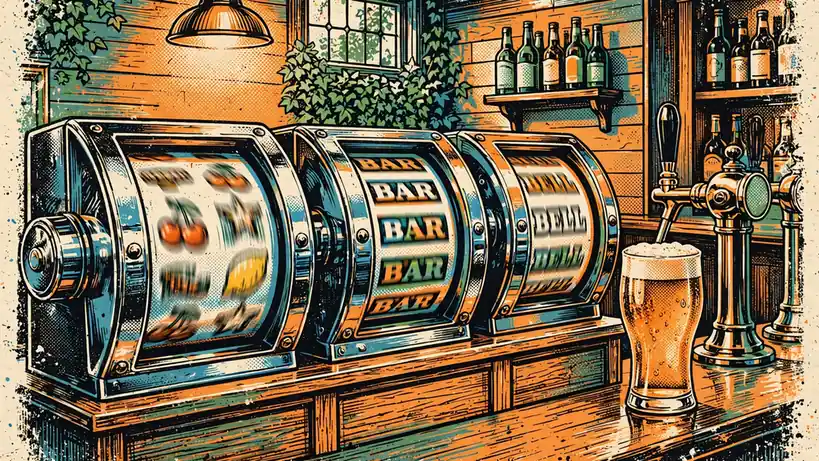
Explore three-reel layouts, classic and video slot differences, and the distinctions between free play and real-money access.
What Defines a Three-Reel Slot
A three-reel slot is defined first by the number of reels presented in its main game area: three vertical columns containing symbols that move and stop to form a result. The term describes the visible reel arrangement, not a particular theme, provider, stake, payout, or way of accessing the game. A title can therefore be recognised as a three-reel slot even when it appears in a modern digital interface rather than on a physical cabinet.
The reels are the central organising feature. Each spin produces a displayed combination across the three columns, with the relevant symbols assessed against the game’s winning arrangement. In the simplest presentation, that arrangement is a single horizontal line through the centre of the reels. A game may also show more than one active line, but the presence of three reels remains the basic format characteristic.
This makes three-reel slots distinct from games built around five reels. A five-reel slot has two additional columns and can display a broader arrangement of symbols at the same time. That difference affects the visual layout and the number of possible combinations represented by the game, although the reel count alone does not establish how frequently a particular result occurs or how much any result pays.
Three reels and five reels
The contrast is best understood as a structural one rather than a judgement about quality. Three-reel slots use a compact reel window, while 5 reel slot games use a wider one. The latter may present several rows and multiple winning paths, but those features are not implied merely by the fact that five reels are present. The exact rules belong to the individual game.
Casino Games: Slots, Table Games and Live Casino
A wager in a five-reel slot can be applied across all five reels. In practical terms, the stake is associated with the complete five-reel game cycle rather than being limited to one selected reel. This is an important distinction from the visual question of how many reels are shown: the number of reels and the way a stake is allocated are related parts of the game’s rules, but they are not the same thing.
The same caution applies to three-reel slots. Three columns do not, by themselves, establish the number of active lines, the value of a symbol, the presence of a jackpot, or the size of any return. Those details require the game’s own rules. The format identifies the reel structure; it does not supply every other mechanical or financial condition.
What the format does—and does not—tell
The phrase “classic three-reel slots” generally points to a compact, traditional visual style, but the word “classic” should not be treated as a technical definition of the reel mechanism. A classic-looking game may use three reels, yet the label alone does not prove that it follows one particular payline arrangement or symbol set. Similarly, a three-reel casino slot can be presented through a digital screen while retaining the recognisable three-column layout associated with traditional machines.
The format also does not determine whether the game is available online, whether it can be opened without a download, or whether it is offered for real-money play. Those are questions about access and operating conditions, not about the number of reels. “Online three-reel slots” therefore describes three-reel games delivered through an online interface, while the underlying structural definition remains unchanged.
A useful description should separate four ideas:
- Reel count: three or five visible reels.
- Display arrangement: the columns and rows shown during a spin.
- Winning rules: the lines or combinations the game evaluates.
- Stake rules: how a wager is attached to the game cycle.
Only the first of these defines a three-reel slot directly. The others vary between titles and cannot be inferred solely from the format.
Reading the layout accurately
The visible result is usually read from left to right, with symbols stopping in their respective reel positions. A winning combination, where one exists under the game’s rules, depends on the arrangement required by that title. Three reels make the layout easy to identify, but they do not make every game identical. Two games can share the same reel count while differing in their symbols, lines, stake settings, and settlement rules.
Five-reel games require the same careful separation. A wider display may offer more positions for combinations, and a bet may cover all five reels, but neither point establishes a universal set of paylines or outcomes. The five-reel label indicates the number of columns; it does not replace the game’s rule sheet.
Reel count Three vertical columns
Format type Three-reel slot
Key distinction Structural layout, not theme or payout
For that reason, the defining feature of a three-reel slot is modest but precise: it is a slot format whose primary playing area contains three reels. References to three-reel slots, three-reel online games, or classic three-reel slots may describe different presentations, but each expression starts from that same structural fact. Further characteristics must be established separately from the individual game’s stated rules.
Three-Reel Games and Machines
The expressions three-reel slot game and three-reel slot machine are closely related, but they do not describe exactly the same thing. The first refers to the gambling game or format. The second refers to the cabinet, terminal, or digital interface through which that game is presented. Keeping the terms separate makes descriptions of three-reel slots more precise.
A reel is the vertical strip that displays symbols and moves during a spin. In a three-reel arrangement, the visible result is built from three such strips. The reels may be physical components in a traditional machine or visual elements rendered on a screen. The appearance of reels alone does not establish whether the machine is mechanical, electronic, or online; it describes the way the symbols are arranged and displayed.
Game, machine and interface
A three-reel slot game is the underlying set of rules, symbols, winning combinations and outcomes. It exists as software in an online casino or as a programmed game in an electronic cabinet. The game determines what happens when a spin is initiated and how the displayed result is interpreted.
A three-reel slot machine is the device that presents that game. In a betting shop, casino or other physical venue, the term can describe a standalone cabinet with a screen, buttons and a payment or account interface. In an online setting, it is often used more loosely for the digital presentation of the game. Strictly speaking, an online page is not a machine in the traditional physical sense; it is an interface through which the software is accessed.
Three-reel slot game
The underlying set of rules, symbols, winning combinations and outcomes.
Three-reel slot machine
The device or interface, such as a physical cabinet or digital screen, that presents the game.
Three-reel slots online
Three-reel games delivered through an internet-based casino interface.
This distinction matters because the same game format can appear through different forms of equipment. A physical cabinet may use illuminated buttons and a dedicated screen, whereas an online version may be controlled through a browser or mobile display. The presentation changes, but the label “three-reel” continues to describe the reel arrangement rather than the surrounding hardware.
The word machine can also carry a historical meaning. In British usage, fruit machine is a familiar term for a physical gambling machine, while slot machine is a broader expression used in descriptions of both land-based and digital products. Neither term, by itself, proves that a game has a particular payout structure, theme or set of special functions.
How the terminology is used
Several descriptions may therefore refer to substantially the same subject:
- Three-reel slot game: the software or game format.
- Three-reel slot machine: the physical or digital apparatus presenting it.
- Three-reel slot: a shortened term that may mean either the game or its presentation, depending on context.
- Three-reel slots online: three-reel games delivered through an internet-based casino interface.
- Free three-reel slots: a description of access conditions, not a separate reel format.
The last expression should be handled carefully. “Free” describes how a game is played or accessed, whereas “three-reel” describes its structure. The two terms answer different questions and should not be treated as interchangeable labels. A game can have three reels regardless of whether it is displayed on a physical cabinet, played through an online interface, or made available in a mode that does not involve a cash stake.
Similarly, a reference to three-reel slot features should identify features that are actually established for the particular game being discussed. The reel count alone does not demonstrate the presence of a bonus round, a special symbol, an expanding reel, a progressive prize or any other additional mechanic. Those characteristics belong to the individual game’s rules, not to the general meaning of “three-reel”.
Physical and digital meanings
When the phrase “three-reel slot machines UK” is used in a land-based context, it normally points to physical gambling equipment available in Britain. When the same wording appears in an online context, it may instead refer to digital games that reproduce the visual idea of a three-reel machine. The setting changes the meaning of machine slightly, although the underlying format remains identifiable by the number of reels.
A careful description should therefore state whether it concerns a game, a cabinet or an interface. This avoids attributing hardware characteristics to software, and it avoids treating an online display as evidence of a particular physical machine design. The terminology is simple, but the distinction prevents several different ideas—format, equipment and access method—from being compressed into one label.
Best RTP Casino Slots UK: How Returns Work
Free Play and Real-Money Play Are Different
The same three-reel presentation can appear in two fundamentally different settings. Free online play is a demonstration mode: the balance shown on screen is fictional, no deposit is required, and any apparent win remains inside the simulation. It does not create a cash entitlement, and no payout is awarded. This distinction matters when a title is described as available to play without registration or as a free online game. Such wording concerns access to a demonstration, not a way to gamble without an account or to withdraw winnings.
Real-money play involves an account, funds that belong to the customer, and gambling activity conducted through an operator authorised for the British market. A result can then affect the account balance, but the financial exposure also changes the significance of the game’s mathematical design. A favourable-looking sequence does not alter the underlying expectation. Where a game gives the operator a positive house edge, repeated play carries a negative expected result over sufficiently many sessions; whether losses emerge quickly or slowly does not change that calculation.
The difference can therefore be stated plainly:
- Free play: fictional funds, no deposit requirement, and no real-money prize.
- Real-money play: deposited or otherwise available funds, an operator account, and outcomes that can increase or reduce the withdrawable balance.
A free version may still be useful for observing the interface or understanding how a three-reel title presents its symbols. It cannot establish that the same title is suitable for gambling with money. Nor does a simulated win demonstrate that a real-money session will produce a comparable result. The two modes may look similar while having entirely different financial consequences.
British limits for online slots
Real-money slot gambling in Great Britain is subject to stake limits that vary by age. A specialist gambling review reports a maximum of £5 per game cycle for customers aged 25 and over, while customers aged 18 to 24 are subject to a £2 maximum. This is a regulatory condition of the online slot market, not a feature of free play: a fictional balance is not a stake and does not fall within the same practical risk.
The limits apply to the amount staked in an individual game cycle. They do not turn a slot into a low-risk activity, remove the house edge, or make a free-play result financially meaningful. They simply restrict the size of each permitted online slot wager for the relevant age group.
Financial Limits
In Great Britain, maximum stakes are restricted to £5 per game cycle for customers aged 25+ and £2 for those aged 18-24.
Real-money access also carries safeguards that have no equivalent in an informal demonstration mode. The operator must establish a customer’s age before allowing funds to be deposited into a gambling account. New customers must be prompted to set a financial limit before making the first deposit, and account controls must allow those limits to be managed. Credit cards cannot be used to fund gambling, including where a money-service business routes the payment. A wallet that permits credit-card funds to be used for gambling is likewise unavailable for this purpose.
These conditions separate a regulated gambling account from a free-play screen. A site presenting a three-reel game without registration may offer only a simulation, whereas a site accepting real funds must operate within the applicable British framework. The presence of a play button, a displayed balance, or a win animation is not enough to establish that money can be won or withdrawn.
Accordingly, descriptions of the best real-money three-reel slots should not be treated as interchangeable with lists of games available to play for free. The former concerns gambling with financial consequences and regulatory controls; the latter concerns entertainment or inspection using money that has no real value. Recognising that boundary is necessary before assessing any individual title or deciding whether an online session involves genuine gambling.
Classic Slots Online: Free Play and Access
Classic-style three-reel slots are available online through casino game libraries, browser-based demonstrations and free-play pages. The label generally signals a straightforward presentation associated with older fruit-machine design: a compact reel display, familiar symbols and a relatively uncluttered interface. It describes the visual and thematic style rather than proving anything about the game’s payout level, fairness or chances of winning.
Access normally begins with selecting a game from an online casino’s slots section. A browser version may load directly on a computer, tablet or mobile device, while some services may offer a dedicated application. The precise interface depends on the operator and provider. A game described as an online casino three-reel slot is therefore not necessarily a physical machine reproduced in every detail; it is an electronic version presented through an online platform.
Free Play
Free online play is a demonstration mode using fictional funds; it does not create any cash entitlement or real-money prize.
Free access without downloading
Free online play is commonly offered through a browser, so a separate software installation may not be required. This can make it possible to inspect the layout, read the paytable and observe the general sequence of play before any gambling account is involved. A no-download version may still require a page to load correctly, and availability can differ between devices or operators.
The balance used in a free version is fictional. It has no cash value, cannot be withdrawn and does not generate real-money payouts. A winning combination displayed in a free classic three-reel slot is therefore only an in-game result. It does not establish that the same outcome would produce a payment in a funded version, nor does practice mode provide a method for converting simulated credits into money.
Free access can nevertheless be useful for examining practical details. The paytable may show which symbols form winning combinations, whether the stake can be altered and how the controls operate. It may also reveal whether the game uses a simple reel display or includes additional features. Such inspection is descriptive, not predictive: observing a sequence of wins in demonstration mode does not improve the probability of a later result.
Interpreting payout claims
Descriptions such as “high payout” are not sufficient evidence of a favourable result. A game’s displayed prize for a particular combination says little by itself about the frequency of that combination, the complete paytable or the mathematical expectation of repeated play. No strategy can guarantee a win on a three-reel slot, and changing the timing of a spin does not control its outcome.
Best Highest RTP Slots UK: How Returns Work
The same caution applies to “old-fashioned” or “classic” wording. These terms identify an aesthetic and may help distinguish a simple reel presentation from a more elaborate video-style interface, but they do not establish a common return, volatility level or prize structure across all titles. Those characteristics require reliable game-specific information.
For that reason, free play is best treated as an access and familiarisation mode. It can show how a title is presented online and whether its controls are intelligible, while leaving the financial distinction clear: simulated credits remain simulated, and no real-money payout follows from a free spin. Real-money access involves separate account, age, funding and regulatory conditions, which are considered independently from the availability of a free browser version.
Playing Three-Reel Slots Online for Money
Playing classic three-reel slots online for real money is permitted in Great Britain only through an operator authorised for the British market. The Gambling Commission regulates commercial gambling in Great Britain and is the sole regulator for that activity, including remote casino services. Its remit applies to gambling offered to consumers in Great Britain even when the operator’s key equipment is located elsewhere.
A casino’s location, branding, or payment interface does not establish that it is authorised. The relevant question is whether the business holds the appropriate current operating licence from the UK Gambling Commission. The Commission issues operating licences to gambling businesses and personal licences to individuals involved in operating gambling activities. The public register should therefore be checked before an account is funded. The licence details displayed by the casino should correspond with the register rather than being accepted as proof on their own.
Verification Steps
- Check the UK Gambling Commission public register for an operator licence
- Verify age requirements are met
- Set a financial limit before making a deposit
- Ensure the chosen payment method is not a credit card
Age and account controls
Real-money play is restricted to adults aged 18 and over. Before a customer can deposit funds into a gambling account, the operator must verify the customer’s age. This requirement applies before funded play begins, not merely after a withdrawal request or a substantial win.
Licensed remote operators must also prompt new customers to set a financial limit before the first deposit. Account-level controls must remain accessible, allowing limits to be reviewed and managed rather than hidden in a separate support process. These measures are relevant whether the chosen game is a classic three-reel title, another slot format, or a different online casino game.
British online slot play also has specific operating restrictions. The total stake in a single game cycle cannot exceed £5 for customers aged 25 or over, or £2 for customers aged 18 to 24. These limits concern online slots and should not be treated as general limits for every casino game. The same restrictions do not apply to roulette or blackjack. Online slot autoplay is banned, and at least 2.5 seconds must pass from the beginning of one game cycle before the next can start.
Funding a real-money account
Credit cards cannot be used for gambling deposits at UK-licensed casinos. The restriction also covers credit-card funding routed through a money service business. A wallet cannot be used for gambling where that wallet permits credit-card funds to finance the transaction. Consequently, a payment method being available in a general online checkout does not mean it can lawfully fund a British gambling account.
Best Bonus Buy Slots UK: How Feature Entry Works
A licensed operator must provide responsible-gambling tools, including self-exclusion, and must offer an internal complaints procedure together with access to an approved Alternative Dispute Resolution service. Operators are also required to contribute to the Research, Education and Treatment levy. These obligations form part of the regulatory framework surrounding real-money slots; they are not features of the three-reel format itself.
Searches for free three-reel slots without registration concern a different arrangement. A free-play version uses fictitious funds and does not award real-money payouts. It should not be treated as a route into funded gambling or as evidence that the operator is authorised for real-money play. Where money is deposited and withdrawals are possible, the UK Gambling Commission licence, age verification, payment restrictions, and account-limit controls become relevant.
Fruit-Machine Paylines, Odds and Volatility
The language of fruit machines often makes paylines sound more uniform than they are. A three-reel machine may display a small number of visible symbol rows, but the number and arrangement of winning lines depend on the particular game. Some machines use a single central line; others allow more than one line or present line-related settings differently. Consequently, “three-reel slot machine paylines” is not a complete specification of a game’s mathematics.
Payline and Odds
A payline is a permitted route through the reel display, whereas odds represent the probability of a specific outcome. The number of reels does not determine the number of paylines or the mathematical probability of winning.
The same caution applies to odds. There is no single set of three-reel slot machine odds that applies to the category as a whole. The probability of a symbol combination depends on the reel layout, the symbols assigned to each reel position, the paytable and any other rules governing winning combinations. A title’s appearance as a fruit machine does not establish its chances of producing a particular result. Nor does a free version alter those underlying descriptions into a general rule: free three-reel slot machines may reproduce a game interface, but their play uses fictitious funds and does not award cash payouts.
Paylines, combinations and machine terminology
A payline identifies a permitted route through the reel display on which matching symbols may be assessed. It should not be confused with the number of reels. Three reels describe the visible reel format; paylines describe how outcomes are evaluated. A machine with three reels can therefore require a different wager structure from another machine with the same number of reels.
This distinction matters when comparing three-reel fruit machines online. The label identifies a style or format, not a universal paytable. Reliable comparison requires the individual game’s rules, including its winning combinations and the way a stake is assigned to them. Without those details, claims that one machine has better odds or more favourable paylines are not substantiated merely by its title or visual design.
Volatility and the distribution of wins
Volatility addresses how returns are distributed over play. Low-volatility slots tend to produce more frequent, smaller wins. Across most titles, such games are described as producing a winning combination every three to six spins on average. That observation concerns the frequency of winning combinations, not a promise of profit or a fixed result for any particular sequence.
Best Live Casino UK: Games, Tables and Rules
High-volatility slots take the opposite pattern: winning combinations occur less often, while individual returns can be larger. A player may therefore experience longer intervals without a win, followed by a less frequent but more substantial payout. Volatility does not determine whether a session ends in profit. It describes the shape of the results, not their certainty.
The distinction is especially important when a compact, traditional-looking machine is compared with a more elaborate online slot. A simple interface does not by itself establish low volatility, and a larger display does not prove high volatility. Those conclusions require game-specific information rather than assumptions based on appearance, number of reels or fruit symbols.
The long-run mathematical position
Frequency and size of wins must also be separated from mathematical expectation. Every game carrying a positive house edge has a negative expectation for the player over a sufficiently large number of sessions. The losses may emerge gradually in a low-volatility game, because smaller wins occur more often, or through sharper fluctuations in a high-volatility game. The underlying expectation remains negative in either case.
Accordingly, paylines and volatility answer different questions. Paylines concern which symbol routes can produce winning combinations; odds concern the probability of particular outcomes; volatility concerns the distribution of returns over time. None of these terms, on its own, demonstrates that a three-reel slot is favourable to the player.
No-Download Play and the Difference from Video Slots
Three-reel slots can be available in a browser without a software download. In that arrangement, the game loads through the casino website and remains accessible through the site’s interface. No-download access describes the delivery method, not the rules, payout status or underlying reel structure. A browser version can therefore be offered for demonstration play or as a real-money game, subject to the conditions attached to that form of access.
Do
- Use free play to inspect the layout and paytable
- Check specific game rules for symbol values and lines
- Verify operator licensing
Don’t
- Assume “classic” implies a specific payout or volatility
- Treat simulated wins as evidence of real-money outcomes
- Use credit cards to fund gambling accounts
The phrase “no deposit” requires more careful interpretation. A game may be available without an initial deposit for free play, but that does not make it a real-money opportunity. In free play, the balance is simulated, the funds are not genuine and no cash payout is awarded. A no-deposit offer, where one exists, is a separate promotional arrangement and cannot be inferred merely from the fact that a game opens without a download. Its terms would need to be established by the operator.
Three-reel slots and video slots
The distinction between three-reel and video slots is primarily a comparison of format and presentation. A three-reel slot is identified by its reel count: the visible game uses three reels as its central layout. “Video slot” is a broader descriptive term associated with digitally presented slot games and does not, by itself, specify a particular reel count. A video slot may therefore use a different layout, but the label alone is not enough to establish its exact mechanics.
The two categories should not be treated as mutually exclusive in every context. A three-reel game presented through an online screen is still a digital game, while “video slot” may describe the electronic presentation rather than a fixed number of reels. Claims about paylines, bonus features, symbols or return rates require information about the individual title and cannot be derived from the category label alone.
Online Slots Payout Percentage: How RTP Works
For the same reason, a no-download three-reel game should not be assumed to be a video slot in the narrower sense sometimes used by casino websites. The reliable distinction is between the game’s reel format and the way it is delivered. Browser access concerns whether installation is required; free play concerns whether the balance and payouts are real; and the three-reel or video-slot description concerns how the game is classified. Keeping those questions separate prevents a technical access feature from being mistaken for a gambling condition or a complete description of the game.
Top online casinos in the UK
- BeOnBetBonus: 100% up to €500 + 100 FS · Payout speed: 1-3 business days
- SlotoSportBonus: 500% up to £ 10 200+ 777 FS · Payout speed: 1-3 business days
- EvoSpinBonus: 125% up to €2500 + 125 Free Spins · Payout speed: 1-3 business days
- NightWinBonus: £900 + 400 free spins · Payout speed: 1-3 business days
- Revery PlayBonus: 100% up to€1,000+ 100 FS · Payout speed: 1-3 business days
- WinBeastBonus: €5000 + 500 FS + €650 Freebet · Payout speed: 1-3 business days
- AmunbetBonus: Join now and get 450% up to 2,700 GBP + 450 FS · Payout speed: 1-3 business days
Three-Reel Slots and the Limits of the Evidence
The category of three-reel slots can be described with confidence at the level of format. It refers to slot games built around three reels, rather than the wider five-reel format commonly found in online casinos. That distinction identifies the basic layout, but it does not establish how any particular title pays, how often it produces winning combinations, or what features accompany its spins.
A format label is therefore a limited piece of information. It may indicate the number of reels while leaving other material questions unanswered, including the number and arrangement of paylines, the presence of bonus features, the volatility profile, and the mathematical return structure. Those characteristics belong to individual games and cannot be inferred merely from the fact that a game has three reels.
The same caution applies to visual descriptions. A three-reel game may be presented with imagery associated with traditional fruit machines, but the reel count alone does not prove that it uses a particular symbol set, payout pattern, interface, or theme. Nor does the label establish whether the game is available in a particular form or through a particular operator.
Summary
- A three-reel slot is defined by its structural reel count, not its theme or payout.
- Visual style (“classic”) does not guarantee specific mathematical mechanics.
- Real-money play in the UK is strictly regulated with specific age and stake limits.
- Demonstration modes use fictional funds and have no real-world financial value.
What can be stated is narrower but more reliable: three-reel slots form a recognisable structural category, defined primarily by their reel layout. What cannot be stated without title-specific documentation is that every game in the category shares identical mechanics, payout conditions, volatility, or presentation.
This distinction matters because a category description is not a performance assessment. The term identifies the general format; it does not, by itself, show whether a particular game is suitable for a given purpose or how its outcomes are distributed.
What ‘Classic’ Means in a Three-Reel Slot
“Classic” is primarily a description of style, not a guarantee of a particular mathematical model. In a three-reel slot, the label commonly signals a deliberately simple presentation associated with traditional fruit-machine imagery and a compact reel layout. It may indicate familiar symbols, straightforward visual design and an emphasis on the basic spin rather than an elaborate theme.
The term should therefore be treated as descriptive rather than technical. It does not, by itself, establish the game’s return profile, volatility, payline arrangement, jackpot structure or bonus features. Those properties belong to the individual game’s rules and paytable. A slot can look traditional while incorporating additional features, just as a visually simple title may still have rules that require separate examination.
The same caution applies to the word “classic” in descriptions of online casino products. It can refer to the appearance of the reels, the symbols, the general presentation or the way the game is marketed. It does not necessarily identify a distinct legal or technical category. A three-reel game may be called classic because its design evokes an older machine style, but the label alone cannot establish how its outcomes are calculated or how its bets are arranged.
First Deposit Bonus Casinos in the UK: What to Check
For the phrase “classic three-reel slot”, the most defensible interpretation is consequently a three-reel game presented in a traditional style. That interpretation helps separate appearance from evidence. The visual language may explain why a game is described as classic; only the published rules can establish its actual mechanics. Where those rules are not available, the label should remain a statement about presentation, not a basis for claims about performance or features.
Classic Slots and Video Slots: A Format Comparison
The distinction between classic slots and video slots is best treated as a broad description of presentation and design, not as a fixed technical classification. “Classic” commonly signals a traditional slot style, often associated with a simple visual arrangement and familiar fruit-machine imagery. “Video slot” generally describes a more screen-led format in which the presentation can accommodate richer graphics, animation and additional game features.
That contrast does not establish a particular reel count, payline structure or payout profile. A three-reel game may be described as classic, but the label alone does not prove how its symbols are arranged, how winning combinations are evaluated or whether any special feature is included. The same caution applies to video slots: the term identifies a broad format, not a single set of mechanics.
The difference also should not be confused with the distinction between a slot game and a slot machine. A game is the underlying gambling product, whereas a machine or online interface is the means through which it is presented. The words “classic” and “video” may therefore describe the game’s style, its visual treatment, or the way an operator categorises it. They do not, by themselves, determine whether the game is offered through a physical machine or an online casino.
For comparisons involving real-money play, presentation is only one consideration. The applicable conditions depend on the operator and the game’s verified rules, while the broad labels provide little reliable information about volatility, paylines or mathematical expectation. A careful comparison can therefore identify the difference in style and screen presentation, but should stop short of assigning mechanical features that have not been confirmed for the particular title.