

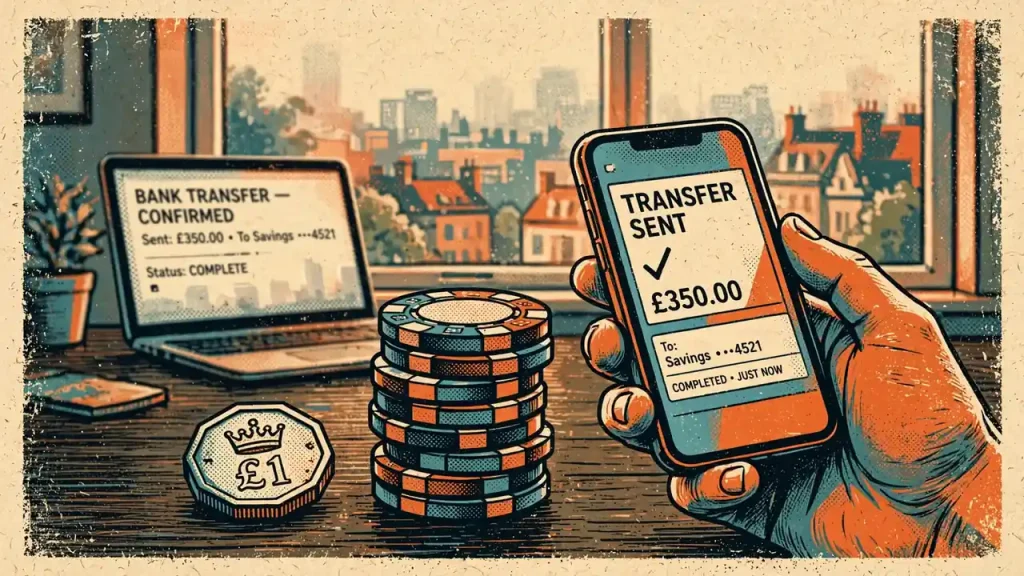
UK casino bank payments can use different processes, so acceptance, processing and payouts depend on the route offered in the cashier.
How Bank Transfers Fit Into UK Casino Payments
Bank transfer is a distinct payment route within the wider range of methods available at UK online casinos. It moves funds from a bank account to the casino’s nominated account or payment service, rather than using a card number or an electronic-wallet balance. The term can cover more than one process, including a conventional bank wire and an open-banking payment initiated through a banking interface. Those routes may appear together in a cashier, but they are not necessarily identical in how a transaction is authorised or processed.
The central attraction of a bank transfer is the direct connection with a bank account. There is no separate wallet balance to maintain, and the payment does not depend on a physical card. This can make the method relevant to customers who prefer their gambling payments to remain visible within ordinary banking records. It also provides a clear distinction from prepaid products: Paysafecard, for instance, is a deposit-only voucher rather than a bank-transfer alternative.
Bank transfers should also be separated from debit-card payments. UK casinos commonly accept debit cards issued on the Visa or Mastercard networks, but a card transaction is authorised by the card issuer and is subject to the characteristics of the particular card product. A bank transfer instead relies on the bank account and the transfer details presented during the payment process. The two methods may therefore have different eligibility conditions even when they are displayed next to each other in a cashier.
Casinos That Accept Wirecard in the UK: Current Status
The presence of a familiar payment brand does not establish that every version of that method is available to every account. A specialist review may list Visa and Mastercard among the payment routes associated with casino sites, while current UK availability and the eligibility of a particular card product still depend on the cashier. That distinction is important for bank transfers as well. A general reference to bank payments does not, by itself, confirm that a conventional wire, an open-banking service, or both can be used for a particular account.
E-wallets form another separate category. PayPal, Skrill and Neteller hold or transmit funds through an intermediary account rather than sending money directly from the customer’s bank account to the casino. Their treatment can also differ from that of bank transfers. A specialist review has reported that PayPal may be excluded from bonus eligibility, while another specialist review has described Skrill and Neteller as available at some sites and often excluded from promotions. Those statements concern particular reviewed arrangements and should not be treated as fixed conditions across the market.
Casino Payments: Compare UK Deposit and Withdrawal Options
Open banking occupies an intermediate position in ordinary descriptions. The payment begins with a bank account, but the authorisation may take place through a connected banking service rather than by entering traditional wire instructions. A specialist review has associated open banking and bank transfers with instant deposits and fast withdrawals at many sites. That observation is not a universal performance standard: the route offered, the account configuration and the casino’s own processing determine what actually happens.
The distinction matters when interpreting descriptions such as “casino wire transfer” or “online casino bank transfer”. A site may use “bank transfer” as a broad cashier label for several banking routes. Elsewhere, “wire transfer” may refer specifically to a bank-to-bank payment requiring account details, whereas an open-banking option may present the same underlying funding source through an integrated payment screen. Terminology alone is therefore insufficient to establish the exact route.
Bank transfer also differs from cryptocurrency payments. Bitcoin and other digital assets are handled through a separate transaction infrastructure and may involve wallet addresses, network charges and asset-price movements. They should not be treated as interchangeable with a sterling bank payment simply because both can appear among casino deposit choices.
The UK regulatory setting places a further boundary around payment comparisons. Remote gambling operators selling into Great Britain must hold the relevant UK Gambling Commission licence, and online gambling is legal in the UK only at licensed and regulated sites. Credit-card payments for gambling are prohibited, including credit-card funding routed through a money service business. A bank transfer cannot be presented as a way around that rule where the underlying funds originate from prohibited credit-card funding. Wallet payments are likewise not permitted where the wallet allows credit-card funds to be used for gambling.
Payment choice is also connected with account controls rather than being an isolated technical preference. Remote gambling operators must prompt new customers to set a financial limit before the first deposit and provide accessible account-level limit controls. That requirement applies independently of whether the selected route is a bank transfer, debit card, open-banking payment or e-wallet.
Main Takeaways
- Bank transfers are a distinct category from cards, e-wallets, and cryptocurrencies.
- Availability and specific transfer types (wire vs. open banking) must be confirmed in the casino cashier.
- Payment compatibility depends on account currency, deposit limits, and verified account status.
- UK regulations prohibit credit-card funding for gambling.
For searches relating to UK casinos that accept wire transfer in 2026, the meaningful question is consequently narrower than whether bank payments exist in the market. It is whether the particular licensed casino displays an appropriate bank-transfer route for the relevant account, and whether that route is the intended type of payment rather than a similarly labelled alternative. General payment lists can establish that bank transfers are a recognised category, but they do not identify a universal list of online casino sites that accept every form of wire transfer. Availability remains a cashier-level matter, with bank transfers occupying their own place beside cards, wallets, vouchers and digital-asset payments.
Top online casinos in the UK
- BeOnBetBonus: 100% up to €500 + 100 FS · Payout speed: 1-3 business days
- SlotoSportBonus: 500% up to £ 10 200+ 777 FS · Payout speed: 1-3 business days
- EvoSpinBonus: 125% up to €2500 + 125 Free Spins · Payout speed: 1-3 business days
- NightWinBonus: £900 + 400 free spins · Payout speed: 1-3 business days
- Revery PlayBonus: 100% up to€1,000+ 100 FS · Payout speed: 1-3 business days
- WinBeastBonus: €5000 + 500 FS + €650 Freebet · Payout speed: 1-3 business days
- AmunbetBonus: Join now and get 450% up to 2,700 GBP + 450 FS · Payout speed: 1-3 business days
Bank Transfer Deposits and Cashier Compatibility
A bank-transfer deposit begins with the casino cashier, not with the banking application. The relevant question is whether the account displays a compatible transfer route and whether that route is enabled for the intended transaction. A general statement that a casino accepts bank transfers is therefore less useful than the payment options shown after registration, age checks and account setup.
The cashier may present a transfer option in different ways. It can appear as a direct bank-transfer service, an open-banking route, or instructions for sending funds from a personal bank account. These routes should not be treated as interchangeable. Their availability, deposit process and withdrawal functionality can differ, so the option must be assessed as it appears within the account rather than inferred from a general payment-method list.
Confirming that the cashier offers the route
A practical compatibility check starts with the deposit page. The bank-transfer option should be visible among the available methods, together with the transaction conditions attached to it. If the cashier shows only cards, wallets or prepaid services, a separate bank transfer should not be assumed to qualify merely because the operator describes transfers elsewhere.
Casinos That Accept Tether in the UK: Payments Explained
The account status can also affect what is displayed. Payment access may depend on completed registration, age verification or other account controls. UK remote gambling operators must verify age before allowing a customer to deposit, and the cashier may therefore remain restricted until that requirement has been met. This is a payment-access condition, not evidence that the operator rejects bank transfers generally.
The payment route should also be checked against the intended direction of funds. A method displayed for deposits is not automatically available for withdrawals. Where the aim is to use a bank transfer for both stages, the cashier terms should indicate whether the same route supports the return of funds. This distinction is particularly important when comparing an ordinary bank transfer with an intermediary service that happens to connect to a bank account.
Account currency and the deposit amount
Currency is part of payment compatibility. A specialist review identifies GBP as a supported account currency on the relevant pages, but the currency assigned to the individual casino account still needs confirmation before the first transaction. If the account is denominated differently, the deposit may involve conversion rather than a straightforward sterling payment.
That distinction can affect the amount credited to the gaming balance. The amount sent from a bank account and the amount recorded by the casino may differ where conversion takes place. Currency information should therefore be checked in the cashier, account settings and transfer instructions before funds are sent. The displayed currency should correspond with the currency selected for the transaction, and any conversion information should be considered alongside the payment route itself.
Do
- Verify the specific transfer route in the casino cashier.
- Match the bank account name with the casino account name.
- Ensure the account currency matches your intended transfer.
Don’t
- Assume a deposit method is also available for withdrawals.
- Use a third-party bank account to fund your account.
- Rely on general payment lists instead of the live cashier.
A transfer instruction that does not clearly identify the account currency creates an avoidable compatibility issue. Sending money before resolving that point can make it harder to determine whether a discrepancy arose at the bank, through an intermediary or within the casino’s payment processing.
Minimum and maximum deposit controls
A specialist review places the minimum deposit for the methods considered at £10–£20, with the exact threshold depending on the selected payment method. That range should not be treated as a universal bank-transfer rule. The cashier’s own minimum is the operative condition for the account and route in use.
The same applies to maximum deposits. A transfer limit may be set per transaction, per day or per month, and the applicable ceiling can vary according to both the method and the account status. A bank’s own transfer limit may exist alongside the casino’s cashier limit, creating two separate controls. The lower applicable limit determines whether the intended payment can be completed in one transaction.
The cashier should therefore be read as a set of transaction conditions rather than as a simple list of logos. The relevant points include:
- whether bank transfer is available for the account;
- whether the displayed route is intended for deposits;
- the currency assigned to the account;
- the minimum deposit for that route;
- any single-transaction ceiling;
- any daily or monthly restriction;
- whether account status changes the available limit;
- whether the route also supports withdrawals.
These checks concern compatibility, not a ranking of payment methods. A route that accepts a deposit may still be unsuitable for a particular amount, currency or intended withdrawal arrangement.
Bank details and payment ownership
Where a casino provides bank-transfer instructions, the payment should follow those instructions precisely. The beneficiary information, reference and amount are part of the identification process. Altering or omitting a required reference can make it more difficult for the operator to match the incoming payment to the correct gambling account.
Ownership is equally important. Account information and payment details belonging to the same customer reduce the likelihood that basic ownership questions will interrupt the transaction. A deposit from an unrelated bank account can create a mismatch between the registered customer and the person sending the funds. That mismatch may require clarification before the balance is credited or before a later withdrawal is processed.
The cleanest arrangement is therefore one named account used consistently for the deposit and, where permitted, the withdrawal. This does not remove the possibility of KYC or other checks, but it avoids introducing an unnecessary discrepancy into the payment record.
Financial limits before the first deposit
Payment compatibility also exists within the account’s responsible-gambling controls. UKGC rules require a remote operator to present a new customer with the opportunity to set a financial limit before the first deposit and to make account-level limit controls accessible. A bank-transfer option may therefore be visible while the account still requires a limit decision before funds can be deposited.
This control should not be confused with the bank-transfer limit. The casino’s financial limit concerns the customer’s gambling account, whereas a transaction, daily or monthly payment ceiling concerns the permitted movement of funds through a particular route. Both can affect whether a deposit proceeds, but they serve different purposes.
The distinction matters where the cashier accepts a bank transfer yet rejects or restricts the proposed amount. The cause may be the selected payment method, the account’s status, the financial controls attached to the gambling account, or a limit imposed by the bank. Compatibility depends on all applicable conditions being satisfied.
Regulatory Note
Online gambling is legal in the UK only at sites licensed and regulated by the UK Gambling Commission.
When a bank-transfer deposit is not the same as a bank-transfer withdrawal
A casino may make a bank-transfer deposit route available without offering the same path for withdrawals. Payment systems can be deposit-only, and a method’s presence in the cashier does not establish that it can receive winnings. The withdrawal page must be checked separately if the intention is to use one banking route in both directions.
The original funding route can also influence the later movement of funds. UK anti-money laundering controls generally require winnings or returned funds to be sent back through the original payment source where that is possible. Returning money to that source is a common anti-fraud and AML measure; an alternative route may require additional verification. For that reason, selecting a deposit method is not merely a question of how funds enter the account. It can affect the documentation and payment path required later.
This is why a description such as “online casino bank transfer withdrawal” should be treated as a separate compatibility question. Deposit acceptance confirms only that the casino has a way to receive funds through the indicated route. It does not by itself confirm that the route can pay funds out, that the same currency will be used, or that the casino will approve an alternative destination.
Regulatory and account checks
For a UKGC-licensed casino, the payment route exists within a regulated account structure. The Gambling Commission requires remote gambling operators serving Great Britain to hold the relevant licence, and legal online gambling in the UK is available through licensed and regulated sites. The licence status should be confirmed on the UKGC public register before a deposit is made.
This check does not replace the cashier review. A licensed operator may support several payment methods, while the particular account may display only some of them. The payment page remains the place to confirm current availability, transaction conditions and the relationship between deposit and withdrawal functionality.
Casinos That Accept E-Wallets in the UK: Payments
Credit-card payments for gambling are not an alternative to a bank transfer at a UK-licensed casino. The regulator introduced the ban on 14 April 2020, and credit-card gambling remains prohibited. The restriction also covers credit-card funding routed through a money service business. Wallet payments are likewise not acceptable where the wallet permits credit-card funds to be used for gambling.
A compatible deposit route is therefore one that is available to the account, permitted under the applicable UK rules, supported for the intended transaction and connected to payment details that can be attributed to the same customer. Bank-transfer availability alone does not establish all four conditions.
What to Check Before a Transfer Is Accepted
A bank transfer is not assessed solely by whether the cashier displays a transfer option. The account holder, payment details and transaction route also matter. A casino that accepts wire transfer deposits may still review whether the incoming funds appear to belong to the registered customer and whether the selected route is available for that account.
Match the account and payment ownership
The most straightforward arrangement is one in which the casino account and the bank account used for funding belong to the same customer. Matching names and account details reduce the likelihood that basic ownership questions interrupt the transaction. This does not guarantee acceptance, since a remote gambling licensee may still apply its own checks, but it removes an avoidable inconsistency at the outset.
The same principle applies when considering an online casino that accepts wire transfer deposits. A transfer initiated from a third party’s account can create uncertainty about who supplied the funds. That uncertainty may lead to a request for further information or prevent the payment from being credited until ownership has been clarified. A payment route in the customer’s own name provides a clearer connection between the casino account and the originating bank account.
Credit-card payments for gambling are prohibited in the UK, including funds routed through money service businesses.
The cleanest arrangement is often one named account used consistently for both deposit and withdrawal. This supports a transparent record of where funds came from and where any approved return should go. It also fits the closed-loop approach associated with gambling-payment controls: the payment path should make sense as a single customer’s transaction rather than as a movement of money between unrelated people.
Check the registered details
Before initiating a transfer, the casino account information should correspond with the identity details held by the bank. Differences in name, address or other registration data can make an otherwise valid payment harder to attribute. A shortened name, a previous surname or an account registered to another person may be enough to prompt a manual review.
The relevant details are not limited to the visible username. The account must have passed the operator’s required age check before funds can be deposited. Remote gambling operators must verify a customer’s age before permitting a gambling deposit, so an incomplete account profile can affect whether a payment is accepted even when the banking information is correct.
KYC may also affect the handling of a transaction. It is therefore important to distinguish between a transfer being sent by a bank and a transfer being accepted by a casino. The banking system may process the instruction, while the casino may hold the funds pending confirmation of the customer’s identity or payment ownership. These are separate stages, and success at the first stage does not establish completion of the second.
Casinos That Accept Interac in the UK: Payment Guide
Confirm the exact route shown in the cashier
A casino that accepts bank wire transfer payments does not necessarily support every form of bank transfer. The available route may depend on the account, the banking provider, the currency or the payment products enabled in the cashier. The appropriate check is the live payment page attached to the registered account, rather than a general statement that a particular method exists somewhere in the market.
The payment instructions should be copied exactly as displayed. The beneficiary details, reference and any customer-specific identifier help the operator associate the incoming funds with the correct account. Omitting or altering such information can delay attribution, even if the bank has accepted the transfer instruction.
The cashier should also be checked for any indication that the route is deposit-only or that withdrawals must use another method. A method should not be treated as a complete payment solution merely because it can be used to send funds. Deposit and withdrawal availability are separate questions, and the intended use should be established before money is moved.
Treat card branding as a separate check
Some specialist reviews list Visa and Mastercard among the payment methods associated with UK-facing casino sites. That type of source can indicate that the brands have appeared in published payment information, but it does not establish current availability for every account or every card product. The cashier remains the relevant place to check whether a particular card can be used.
This distinction is especially important for a bank wire transfer casino comparison. Card acceptance does not confirm wire-transfer acceptance, and the presence of a bank-transfer label does not confirm that a debit card, prepaid card or other product will be eligible. Each route has its own conditions. Payment branding should therefore be treated as an indication to verify, not as proof that a transaction will proceed.
Understanding Card Branding
While brands like Visa and Mastercard are common in the market, their presence in reviews does not guarantee availability for every specific card product or account at a particular casino.
Credit-card payments for gambling are prohibited at UK-licensed casinos, including credit-card funding routed through a money service business. A payment option must therefore be assessed according to the underlying funding source, not simply the name or interface of an intermediary. Wallet payments are also not permitted where the wallet allows credit-card funds to be used for gambling.
Resolve inconsistencies before sending funds
Where account ownership, payment ownership and cashier instructions point to the same customer, the basic acceptance position is clearer. Where they do not, sending the transfer first can create an avoidable dispute over attribution. The sensible order is to correct the account details, confirm the available route and then follow the displayed instructions.
A UKGC casino bank-transfer option should be understood in this limited sense: the operator’s cashier must show the route for the relevant account, and the transaction must satisfy the operator’s ownership and identity checks. No general list of payment brands can replace that account-level confirmation. The practical question is not whether a casino has ever mentioned bank transfers, but whether the named customer can use the displayed route under the terms attached to that account.
Transfer Timing, Cut-Offs and Currency Conversion
A bank transfer to or from a casino is not governed by one timetable. The movement of funds can involve the casino’s payment process, the banking system, any intermediary provider and, where relevant, currency conversion. Each stage may introduce its own processing point. For that reason, the time at which a transfer is initiated does not necessarily match the time at which the casino records it or makes the balance available.
A specialist review source identifies three material influences on bank-transfer delivery: the relevant cut-off time, non-working days and currency conversion. These factors concern the mechanics of the payment rather than whether a particular casino offers bank transfer as a cashier option.
Casinos That Accept Bitcoin in the UK: What to Check
How cut-off times affect a transfer
Banks and payment services may process instructions within defined operating windows. An instruction submitted before a cut-off can enter processing on the same working day, while one submitted after that point may be treated as received during the next processing window. The exact treatment depends on the institution handling the payment and on the route used.
The casino’s own finance process can create a separate timing point. A transfer may have reached the banking network while still awaiting recognition in the casino account. Conversely, a casino may mark a payment as processed while the receiving bank has not yet posted the funds. These are different events and should not be treated as interchangeable.
A clear record of the instruction time, transaction reference and stated processing status helps distinguish a banking delay from a casino-side delay. The relevant timestamp is the one supplied by the institution that accepted the payment, not necessarily the time displayed in a casino account. Where a transfer is pending, the status should be interpreted alongside the provider’s processing window and any notice about non-working days.
Weekends and non-working days
Weekends can interrupt the movement of a bank transfer even when the payment instruction has already been created. A transaction submitted near the end of a working day may not progress until the next available banking window. Public holidays can have the same effect. The impact is not limited to the sending bank: an intermediary or receiving institution may operate on a different schedule.
This means that elapsed calendar time and processing time are not identical. A payment initiated shortly before a weekend may remain unchanged in the account view until banking operations resume. The absence of a balance update during that interval does not, by itself, establish that the instruction failed.
Timing Factors
Bank transfers can be affected by banking cut-off times, weekends, public holidays, and potential currency conversion processes.
The same distinction matters for a wire transfer used in connection with a casino withdrawal. A bank may show the transaction as sent before the receiving account shows the credit. The transfer route, the institutions involved and their operating schedules determine how the stages line up. A precise delivery statement therefore requires the terms applying to the particular payment route rather than a general promise about bank-transfer speed.
Currency and the path of the payment
Currency conversion adds another variable. When the casino account, sending account and receiving account use different currencies, the payment may need to be converted during the transaction. The conversion can occur through the casino, a payment provider, a bank or another institution involved in the route. Each arrangement can apply its own exchange rate and treatment of associated costs.
The account currency should be established before a first transaction. A specialist review source reports that the supplied casino pages present GBP as supported, but the operative currency remains an account-level matter to confirm. If the casino balance is held in pounds while the bank account is denominated in another currency, the final credited amount may differ from the amount expected from a simple exchange-rate calculation.
Casinos That Accept WebMoney in the UK: What’s Verified
Currency conversion also affects timing. A payment requiring an additional conversion stage may not follow the same process as a domestic transfer made in the account currency. The transaction may need to pass through a provider’s foreign-exchange process before the receiving institution can post the converted amount. This does not establish a fixed delay, but it does explain why two transfers with similar instructions may not produce identical results.
The displayed exchange rate deserves attention alongside the amount. A payment can contain a conversion spread: the difference between the reference rate and the rate applied to the transaction. A specialist review source warns that this spread can cost more than a visible flat charge. The apparent absence of a separate transfer fee therefore does not prove that the payment is cost-free.
Where payment costs can arise
The total cost of a bank-transfer payment may be distributed across several parties. Potential components include:
- a charge imposed by the casino;
- a fee from the payment provider;
- a sending or receiving bank fee;
- an issuer charge;
- an exchange-rate spread;
- a network fee.
Not every transfer includes every component, and the amount depends on the actual route and transaction. A casino may describe its own charge while the bank or provider applies a separate amount. A receiving institution may also deduct a fee before posting the funds, leaving the credited balance lower than the amount sent.
The distinction between a fixed fee and a percentage-based exchange cost is important. A visible charge is easy to identify in a payment summary, whereas a less favourable conversion rate may be reflected only in the difference between the transferred amount and the amount credited. Both affect the economic result of the transaction.
For that reason, there is no universal lowest-fee payment method. A meaningful comparison has to include casino charges, provider fees, currency spread and network cost for the particular amount and route. A bank transfer that appears inexpensive at the casino cashier may carry a cost elsewhere in the chain, while a route with a stated fee may produce a different overall result once conversion is included.
Reading a transfer estimate accurately
A timing estimate should be separated into the stages it actually covers. “Processed” may describe the casino’s internal action, whereas “sent” may describe release to a bank or provider. “Received” normally refers to posting in the destination account. These labels should not be assumed to describe the same point in the transaction.
Does a bank transfer always arrive instantly?
No, delivery depends on the banking window, whether it is a working day, and if any currency conversion is required.
Can I use the same bank transfer for withdrawals?
Not necessarily; you must check the cashier to see if the specific route supports both deposits and withdrawals.
Why is my withdrawal pending?
A pending status may mean the casino is still conducting internal approvals, identity verification, or AML checks.
The currency used for the estimate also matters. A timetable for a domestic payment in the account currency cannot automatically be applied to an international or converted payment. Cut-off rules, weekends and conversion can alter the sequence even when the casino cashier presents the method under a single bank-transfer label.
A bank-transfer payment for an online casino is therefore best understood as a chain of separate processing events. The time of initiation, the applicable banking window, non-working days and any currency conversion all belong to that chain. The cost requires the same approach: casino, provider, bank, exchange-rate and network charges must be considered together rather than judged from one displayed fee.
Receiving Casino Winnings by Bank Transfer
A bank-transfer withdrawal is not simply the reverse of making a deposit. The casino must first approve the request, apply its payment controls and confirm that the destination is acceptable. For a wire transfer casino withdrawal, the relevant question is therefore not only whether the cashier displays bank transfer as a method, but also how the operator links the payout to the account and to the earlier funding activity.
Why the original payment source matters
UK anti-money laundering rules generally require gambling winnings to be returned to the original payment source. This is part of the control framework used to establish where funds came from and where they are being sent. A casino wire transfer withdrawal may therefore be handled differently from a payout requested through an e-wallet or a card, even when the amount and account are the same.
The cleanest arrangement is a consistent payment trail: the casino account, the bank details and the original deposit route should belong to the same customer. Returning funds to that source is also a common anti-fraud and AML control. It helps the operator check that the withdrawal is not being redirected to an unrelated person or account.
Casinos That Accept EntroPay in the UK: Payment Guide
This does not mean that every casino will process a bank transfer automatically after a different payment method was used for the deposit. A request to send funds elsewhere may be refused, redirected to the original source or referred for additional checks. Alternative payout arrangements can require further verification because the operator must establish ownership and the reason for changing the destination.
What happens during withdrawal approval
The displayed withdrawal status may cover more than the movement of money between banks. Processing time can include the casino’s internal approval stage, payment handling and any account checks that remain outstanding. A bank may not be involved in the first part of the process at all: the request can remain under review before it is released for transfer.
A specialist review has reported that first withdrawals may take longer while verification is completed. That observation should be treated as a description of one reviewed payment process, not as a fixed timetable for every wire transfer casino in the UK. The same review-based evidence indicates that withdrawal speed depends on the operator’s internal approval procedure and on whether the account is fully verified.
The distinction is important. A delay before approval is different from a delay after the casino has authorised the payment. In the first case, the outstanding issue may concern identity, ownership or AML controls. In the second, the casino may already have released the funds and the remaining movement may depend on the banking route. A withdrawal page that shows only a general status may not identify which stage has caused the delay.
Final Conclusion
Successful bank transfers require matching ownership, verified accounts, and careful confirmation of the specific route offered in the cashier.
First payouts and account checks
The first payout often receives closer scrutiny because it is the point at which the operator must connect the account, the deposit history and the proposed destination. If verification has not been completed, the request may remain pending until the casino has enough information to approve it. This is why a first withdrawal can take longer than a later request, according to the type of specialist review described above.
The requirement is not limited to a wire transfer casino withdrawal. The same principle applies whenever money leaves a gambling account: the operator needs to assess whether the request is consistent with the account holder and the recorded payment activity. A bank transfer can make the destination relationship particularly visible because it is directed to a named bank account rather than an anonymous cash endpoint.
If an alternative destination is proposed, additional verification may be required. The purpose is not merely administrative. It supports the anti-fraud and anti-money-laundering checks that govern the movement of gambling funds. A request may therefore need to be reconsidered if the bank account is held in another name or if it does not correspond with the payment source used for the account.
What a pending status can mean
“Pending” does not, by itself, establish that a bank has received the payment or that the casino has rejected it. It may indicate that internal approval is incomplete, that verification is still being assessed or that the payout has not yet been released to the banking channel. The operator’s payment terms and account messages are consequently more informative than the label alone.
For casino winnings by wire transfer, the practical sequence is:
- The withdrawal request is recorded against the gambling account.
- The casino checks the request and the account’s verification status.
- The payment destination is assessed against the original source and ownership details.
- The operator approves, redirects, requests further information or declines the method.
- Once released, the transfer proceeds through the relevant banking route.
The sequence explains why a withdrawal can take longer than expected without implying that the banking system is solely responsible. It also explains why a fully verified account and a matching payment route can reduce avoidable complications, while not guaranteeing a particular processing time.
A bank-transfer payout should therefore be assessed as a controlled, staged transaction rather than an instant reversal of a deposit. In the UK context, the original payment source, internal approval and account verification are central to whether winnings are released and how the withdrawal is handled.
Choosing a Transfer Route Without Assuming It Is the Best
A bank transfer is not automatically the best payment route for a UK casino account. The relevant comparison is between the complete transaction paths: the casino’s available cashier methods, the payment provider’s charges, any bank or network costs, currency conversion, and the time taken for approval and settlement.
Speed should also be separated into deposit speed and withdrawal speed. A card deposit may appear immediately, while the corresponding payout can take several business days. Conversely, a specialist review has described PayPal, open banking services and debit cards connected to fast payout systems as among the quicker withdrawal options. That observation is method-specific and should not be treated as a permanent market rule.
Casinos That Accept Giropay in the UK
For a bank-transfer route, the practical advantage may lie in using a named account consistently for both sides of the transaction. UK anti-money-laundering controls commonly direct funds back to the original payment source, while an alternative route can require further checks. This makes compatibility and ownership more important than a label such as “best”.
Cost also needs to be assessed against the actual transaction. A visible casino fee is only one possible charge: the payment provider, bank, issuer, exchange-rate spread and network may add others. A conversion spread can outweigh a flat fee, so a supposedly inexpensive route may not produce the lowest overall cost.
The soundest comparison therefore asks whether the method supports the intended deposit and withdrawal, uses the account’s currency appropriately, and offers acceptable processing conditions. A bank transfer may suit one account and transaction better than PayPal, a card or another method, but the available evidence does not justify naming one route as universally superior.
Which payment methods are accepted in Great Britain?
UK casinos commonly accept Visa and Mastercard debit cards, bank transfers, and some e-wallets; certain sites also offer Apple Pay or cryptocurrencies. Check the casino cashier for the methods available to your account.
Can I deposit in GBP?
Yes, GBP is supported, but confirm your account currency before depositing to avoid conversion.
What is the current minimum deposit?
The minimum deposit usually starts at £10–£20, depending on the payment method.
Why must withdrawals return to the deposit method?
Returning funds to the original payment source is a common anti-fraud and anti-money-laundering control. An alternative payout route may require additional verification.