

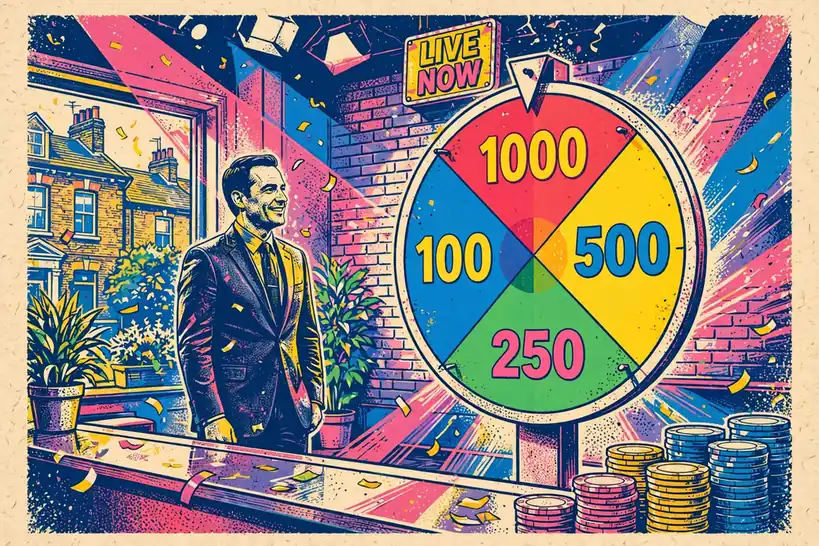
A clear guide to Crazy Time’s live format, UK casino verification, free play and the limits of claims about strategy and outcomes.
What Crazy Time Is—and What the Available Evidence Can Establish
Crazy Time is presented as a live casino game show rather than as a conventional digital table game. Its format combines a studio broadcast with a game interface, placing a presenter and a physical set at the centre of the experience. The title is associated with Evolution, a live-casino game provider, and is offered within the wider category commonly described as live casino.
The word “live” refers to the streamed studio presentation and interaction with a presenter, not to a guarantee of any particular outcome. A casino may display the game within a live-casino lobby, where it appears alongside other streamed table and game-show products. That placement describes how the product is presented; it does not, by itself, establish the legal status of the operator hosting it.
Searches for a Crazy Time casino in the UK can therefore refer to several different matters. They may concern the identity of the game, its live presentation, the availability of a Crazy Time table at a casino serving British customers, or the regulatory position of that casino. These are distinct questions. The game’s existence and provider do not establish that every site mentioning it is authorised to offer remote gambling in Great Britain.
The same distinction applies to descriptions of the game itself. A product name and a live broadcast identify the general format, but they do not establish particular payout figures, bonus features, statistical advantages, minimum wagers or maximum wagers. Such details depend on the relevant game documentation and the terms displayed by the operator. They should not be inferred merely from the title “Crazy Time” or from the fact that the game is shown live.
The term “casino” also needs careful treatment. Under the Gambling Act 2005, a casino is an arrangement that gives people an opportunity to participate in one or more casino games. In online use, however, the word may appear in a brand name, a promotional description or a website category. It is not evidence, by itself, that the business holds permission to provide gambling to customers in Great Britain.
Casino Games: Slots, Table Games and Live Casino
Crazy Time live casino content is consequently best understood as a product description, not as a finding about a particular UK operator. A site can advertise or catalogue a game while separate questions remain about its licensing, account controls, payment methods and complaints arrangements. Those matters concern the operator and the legal framework rather than the identity of the game.
There is also an important boundary between describing a game and recommending it. Calling Crazy Time a live casino game show explains its presentation and category. It does not establish that it offers a favourable chance of winning, that any strategy can overcome chance, or that participation is suitable for a particular person. Gambling should be limited to money that can be afforded to lose. Age and operator safeguards are separate conditions of lawful gambling and should not be treated as implied by the game’s branding.
Crazy Time at UK Online Casinos: Licensing and Verification
A casino advertising Crazy Time to customers in Great Britain falls within the UK gambling licensing framework. The relevant question is not where the website is hosted or where its technical equipment is located. It is whether the business offers remote gambling to consumers in Great Britain and therefore has the appropriate permission from the UK Gambling Commission.
The Commission is the sole regulator for commercial gambling in Great Britain. Its remit includes online casinos and other forms of remote gambling, so a website presenting itself as a UK-facing casino cannot avoid the regulatory system merely by operating from another country. The location of servers, studios, offices or other key equipment does not alter that position.
Which regulator has authority?
The UK Gambling Commission regulates gambling activity across the United Kingdom, although the legal framework is not identical in every part of the UK. For remote gambling directed at consumers in Great Britain, the Commission is the central licensing authority. This distinction matters when a website describes itself as international or refers prominently to an overseas licence.
An offshore authorisation is not a substitute for permission to serve the British market. The relevant check is whether the operator has the required UK Gambling Commission authorisation.
An offshore authorisation is not a substitute for permission to serve the British market. A company may be incorporated elsewhere and may hold approval from a foreign regulator, but that fact alone does not establish that it may lawfully offer online casino gambling to customers in Great Britain. The relevant check is whether the operator has the required UK Gambling Commission authorisation for its activity.
This applies whether the site is being considered as a place to find Crazy Time, another live casino product or a different form of online gambling. The game title does not create an exemption from the operator-licensing requirement. A casino offering it to Great Britain consumers must still fall within the regulatory structure that governs remote gambling.
Operating licences and personal licences
The Commission distinguishes between licences held by businesses and licences held by individuals. An operating licence is issued to the company responsible for providing the gambling service. Personal licences concern individuals whose roles and responsibilities place them within the Commission’s licensing system.
That difference helps explain why a website may display several names in its legal information. The corporate operator, a trading brand, a software provider and named personnel are not necessarily the same entity. The operating licence should correspond to the business actually offering the gambling service, rather than simply to a game developer or a brand mentioned in promotional material.
Deal or No Deal Casino UK: Slot Formats Explained
A site’s terms and conditions should identify the legal entity responsible for the account and gambling service. The name shown there should be capable of being matched with the operator information in the Commission’s public register. A provider’s reputation, the appearance of a familiar game title or the presence of a British-looking web address does not replace that comparison.
Personal licensing is also not a substitute for an operating licence. A named individual may hold a personal licence, but that does not by itself authorise a company to offer remote casino gambling. The business offering the service needs the appropriate operating permission, while personal licensing applies to relevant individuals within the regulated operation.
What the register can establish
The Commission’s public register is the principal verification point for a claimed British gambling authorisation. It can be used to compare the legal operator’s name, trading information and stated website details with what appears on the casino itself. The comparison should be made against the entity actually accepting customers, not just against a related company or a software brand.
The domain is particularly important because a licensed group may operate several brands. A licence entry for one website does not automatically prove that every other domain using a similar name is covered. The brand, domain and corporate entity need to align sufficiently for the register entry to support the claim being made.
The register is a changing record rather than a permanent certificate. Licence status, trading details and business arrangements can change, so a historical result should not be treated as proof of the current position. The date of any register check should be noted when the result is recorded, especially where a website’s claims or details appear inconsistent.
Attention A specialist review reported that the public Commission register dated 26 September 2026 did not show a LuckyPays entry under that brand or its stated domain, including luckypays.io.
A specialist review reported that the public Commission register dated 26 September 2026 did not show a LuckyPays entry under that brand or its stated domain, including luckypays.io. That observation is tied to the register date and to the particular review; it should not be converted into a timeless statement about the operator’s present status. The appropriate verification remains a direct comparison with the current Commission register before any account is funded.
Brand names can obscure the legal operator
Casino brands often use names that differ from the registered business. This is not, by itself, evidence of wrongdoing, but it makes the legal identity more important. A page promoting Crazy Time may emphasise the brand while placing the operating company in the footer, terms, privacy notice or account documentation.
The following details should be consistent:
- the company named in the casino’s terms;
- the operator identified during account registration;
- the business shown in the Commission’s register;
- the website or domain associated with that register entry; and
- the licence information displayed on the casino’s own pages.
A mismatch requires clarification rather than assumption. For instance, a brand may belong to a licensed group, but that relationship should be identifiable from the operator’s legal documents and the register. A logo, a copied licence badge or a statement that the casino is “UK regulated” is not independently sufficient.
The same principle applies to affiliate pages and third-party listings. A directory or review can describe a casino as licensed, but the statement remains secondary until the named operator and domain have been checked against the regulator’s information. Promotional language can also become outdated when a business changes its brand, ownership or licence status.
Why location claims are insufficient
A casino may use British currency, refer to Great Britain or present customer support in English without holding the relevant local operating licence. Conversely, a company may be based outside Great Britain while still needing Commission authorisation because it offers remote gambling to consumers in the jurisdiction.
The regulatory test therefore concerns the service and its customers, not the apparent nationality of the website. A foreign office, overseas server or international corporate structure does not remove the obligation to obtain the relevant permission when the operator targets the British market.
This is also why a foreign licence should be treated as separate information. It may indicate regulation in another jurisdiction, but it does not answer whether the casino is authorised by the UK Gambling Commission. For a search involving Crazy Time casinos in the UK, that local authorisation is the material point.
Checking before account creation and deposit
Verification is most useful before personal information is submitted or funds are transferred. The casino’s legal pages should first be examined for the operating company and the exact domain associated with the service. Those details can then be compared with the Commission’s public register.
Crash Casino Games in the UK: How They Work
The licence should be checked directly on the regulator’s website rather than through a link supplied only by the casino. The register entry should relate to the business providing the remote gambling service. Where the casino gives only a brand name, omits its company details or provides a licence number that cannot be matched, its regulatory claim has not been established.
This process does not determine whether Crazy Time is available at a particular site, nor does it assess the quality of the casino. It addresses a narrower preliminary issue: whether the business claiming to offer online casino gambling to Great Britain consumers can be connected to the required local operating authorisation.
Age and identity controls are part of the regulated setting as well. An operator must verify a customer’s age before allowing deposits into a gambling account. A site that invites immediate funding while postponing meaningful age verification presents a material inconsistency with the requirements applying to licensed remote operators.
The presence of an age check does not, on its own, prove that a casino is licensed. It is one feature of the operator’s compliance arrangements, not a replacement for checking the company and domain in the Commission’s register.
Regulatory verification is not game verification
A valid operator licence does not prove every claim made about a particular game. It establishes a regulatory relationship between the business and the Commission; it does not independently confirm that a website currently carries a particular title, that a displayed game is supplied by a particular provider or that promotional descriptions are accurate.
Those questions should be kept separate. First, the identity and licensing status of the casino must be established. Only then is it meaningful to examine the site’s own catalogue and terms for information about Crazy Time. Treating a game listing as evidence of licensing reverses the order of verification.
Online Casino Games for Real Cash in the UK
The same separation prevents a provider’s identity from being mistaken for the operator’s. A recognised game supplier may appear on a casino page, but the supplier is not necessarily the business accepting the wager or holding the customer account. The operator remains responsible for having the appropriate permission to offer remote gambling to Great Britain consumers.
When the claim cannot be confirmed
If the register does not provide a clear match for the company, brand and domain, the casino’s UK regulatory status remains unconfirmed. That is different from proving that the business has no licence, but it is enough to prevent a confident conclusion that it is a lawful UK-facing operator.
A claimed licence number that leads to another company, another website or unrelated gambling activity is not a satisfactory match. Nor is a page that uses the Commission’s name without identifying the licensed entity. The uncertainty should remain explicit rather than being resolved through inference from design, language, payment options or the availability of a well-known live casino game.
For Crazy Time online casinos serving Great Britain, licensing verification is therefore a question of operator identity, jurisdiction and current register information. The relevant evidence is the Commission’s record for the business and domain offering the service, not the casino’s marketing description alone.
How to Assess a Casino Offering Crazy Time
A site presented as a place to play Crazy Time should be assessed as a gambling operator first and as a game catalogue second. Claims such as “best Crazy Time casino” or “best UK casino sites for Crazy Time” do not establish either licensing status or service quality. A reliable assessment begins with checks that can be made independently of promotional language.
Verify the licence before depositing
A remote operator serving consumers in Great Britain must hold the relevant licence from the UK Gambling Commission. The operator’s website should identify the licensed business, its licence details and the domain covered by that authorisation. Those details should then be checked against the Commission’s public register before an account is funded.
Do
- Check the regulator’s public register directly
- Ensure the brand and domain align with the register
- Verify the legal entity in the terms and conditions
Don’t
- Rely on a logo or licence badge displayed on the page
- Assume an overseas licence is valid for the UK market
- Trust a ranking label or bonus banner as proof of legality
A logo or licence number displayed on a webpage is not sufficient by itself. The register should correspond with the business name, trading identity and website address. Any mismatch is a reason to stop the assessment rather than assume that the casino is authorised. This check is more significant than a ranking label, a bonus banner or a claim to have the latest Crazy Time casino result.
The register confirms regulatory status, not that every promotional statement is accurate. The game’s presence should still be checked within the casino’s own lobby, and the terms applying to deposits, withdrawals and promotions should be read separately.
Check age and account controls
A licensed operator must verify a customer’s age before allowing deposits into a gambling account. The process may also involve identity and address checks. Requests for documentation are therefore not, by themselves, evidence of poor service; they form part of the controls applied to legal gambling accounts.
Account settings provide another useful test. New customers must be prompted to set a financial limit before making the first deposit, and the operator must provide accessible account-level limit controls. These tools should be visible and understandable rather than buried among general account information. A casino that makes promotional material prominent while making limits difficult to locate warrants particular caution.
Examine payment restrictions
Payment methods should be assessed for regulatory compliance as well as convenience. Remote operators cannot accept credit-card payments for gambling, including credit-card funding routed through a money service business. A wallet cannot be used where its structure allows credit-card funds to finance gambling.
Consequently, a payment page that appears to offer many funding routes should not be treated as evidence of suitability. The relevant question is whether the method is permitted for gambling and whether the withdrawal conditions are stated clearly. Promotional claims about Crazy Time casino bonuses also require separate scrutiny: eligibility rules, play-through requirements, expiry conditions and withdrawal restrictions can materially affect their value. No bonus should be treated as a substitute for checking the operator.
Casino Dice Games in the UK: How Online Play Works
Review complaints and safer-gambling arrangements
A UK-licensed casino must provide an internal complaints process and access to an approved Alternative Dispute Resolution service. The procedure should explain where a complaint is submitted, how it is handled and what escalation route is available if the dispute remains unresolved.
Responsible-gambling provisions should be equally visible. UKGC-licensed casinos must provide safer-gambling tools, including self-exclusion. GAMSTOP may also be relevant to people seeking exclusion across participating licensed operators, while GamCare, BeGambleAware and Gamblers Anonymous provide different forms of support. These services do not make gambling risk-free.
Searches for Crazy Time casino results or a particular casino result should not be confused with evidence about operator safety. Results describe game events; they do not verify licensing, payment compliance or complaint arrangements. The essential standard remains administrative and regulatory: confirm the licence, verify age controls, inspect limits, check lawful payment methods and identify the available safeguards. Gambling should remain limited to money that can be afforded to lose.
Where Crazy Time Fits Among Live Casino Games
Crazy Time belongs to the live-casino category: a format in which a casino game is presented as a hosted, streamed event rather than solely through an animated interface. Its position within that category is best understood by comparison with the wider range of games available, rather than by treating the title as a separate type of gambling venue.
The surrounding live-casino catalogue can include traditional table games such as roulette and blackjack, as well as card games with different rule structures. Texas Hold’em is another example of a named card game that may appear in such a catalogue. The presence of a live host does not make these games interchangeable. Their rules, decision points and outcome structures remain distinct, so a casino offering several live products is presenting a selection rather than one unified game.
A documented example of this broader development is Grosvenor’s live-casino launch in 2013. Its initial range included Blackjack, Texas Hold’em and Roulette. That history places live casino within an established product category in the UK, rather than presenting it as a format created specifically for Crazy Time.
Wheel-led titles
Products whose presentation centres on a wheel, such as Crazy Time and Dream Catcher.
Card-based tables
Products like Blackjack, Infinite Blackjack and Texas Hold’em.
Roulette products
Including Lightning Roulette and conventional roulette tables.
Other live formats
Titles such as Common Draw, assessed on their own published rules.
Crazy Time and wheel-based live games
Crazy Time is commonly associated with a prominent wheel, which is why descriptions of a “Crazy Time wheel” can refer either to the visual centre of the presentation or to the game as a whole. The wheel is an identifying feature of the product’s presentation, but the term alone does not establish the complete rules, available outcomes or any particular return.
The same caution applies when Crazy Time is compared with other named live products. Dream Catcher is another wheel-associated title that can be discussed alongside it, but a shared visual element does not make the two games equivalent. A catalogue may also contain Common Draw, Infinite Blackjack or Lightning Roulette. Those names indicate separate products, not alternative labels for Crazy Time.
Reading a live-casino catalogue
A sensible comparison therefore begins with the type of experience being offered:
- Wheel-led titles — products whose presentation centres on a wheel, including Crazy Time and Dream Catcher.
- Card-based tables — products such as Blackjack, Infinite Blackjack and Texas Hold’em, where the title identifies a card-game format.
- Roulette products — including Lightning Roulette and conventional roulette tables.
- Other live formats — titles such as Common Draw, which should be assessed on their own published rules rather than grouped with wheel or table games.
This classification helps distinguish a request to find Crazy Time from a general search for live casino games. A casino may offer a broad live section without carrying every named product, and the existence of a live table does not establish that Crazy Time is included. Conversely, a catalogue that lists Crazy Time may place it beside conventional tables and other game-show-style products.
The available product names support a comparison of categories and presentation styles, but not a ranking of the “top” Crazy Time casinos or a claim that one live format is superior. Selection remains a question of which games a particular licensed operator lists and how clearly it identifies them. In every case, gambling should be limited to money that can be afforded to be lost.
Top online casinos in the UK
- BeOnBetBonus: 100% up to €500 + 100 FS · Payout speed: 1-3 business days
- SlotoSportBonus: 500% up to £ 10 200+ 777 FS · Payout speed: 1-3 business days
- EvoSpinBonus: 125% up to €2500 + 125 Free Spins · Payout speed: 1-3 business days
- NightWinBonus: £900 + 400 free spins · Payout speed: 1-3 business days
- Revery PlayBonus: 100% up to€1,000+ 100 FS · Payout speed: 1-3 business days
- WinBeastBonus: €5000 + 500 FS + €650 Freebet · Payout speed: 1-3 business days
- AmunbetBonus: Join now and get 450% up to 2,700 GBP + 450 FS · Payout speed: 1-3 business days
Strategy Claims and the Limits of What Can Be Established
What a strategy can and cannot do
Claims about a Crazy Time casino strategy often combine two different ideas: managing the way wagers are placed and predicting which outcome will appear next. These should not be treated as equivalent. A staking plan may organise decisions, while a prediction system would need a dependable connection between previous results and future ones. A sequence of earlier results, by itself, does not establish such a connection.
Past outcomes therefore provide a record, not a demonstrated forecasting tool. A tracker may display previous rounds, selected segments or other historical information, but recording results does not alter the underlying game. Labels such as “due”, “overdue” or “hot” describe a pattern imposed on the record; they do not prove that a particular result has become more likely.
Assessing strategy claims
A credible assessment separates an observable feature from the conclusion drawn from it. The following distinctions are useful:
- Recorded information: a history of earlier outcomes can be checked as a record.
- Interpretation: a claim that the record reveals a repeatable pattern requires supporting evidence.
- Prediction: a forecast of the next result requires more than a sequence of previous results.
- Profit claim: an assertion that a method produces reliable winnings requires sustained, independently verifiable results rather than selected examples.
This distinction applies to progressive staking systems as well. Increasing a wager after a loss changes the size of later exposure; it does not demonstrate that the next outcome will compensate for the earlier one. A system may produce a favourable short sequence while still carrying substantial risk when the sequence continues in the opposite direction. The language of “recovery”, “correction” or “guaranteed profit” should therefore be treated as a description of an aspiration, not as evidence of a functioning method.
Trackers and historical records
The term “Crazy Time tracker” can refer to a simple results log, a statistics display or a service that presents predictions. These categories have different evidential status. A log can help reconstruct what has occurred. A display can summarise selected observations. Neither function, without further validation, establishes that future outcomes can be forecast accurately.
The history of a casino game may be relevant to understanding how a product has been presented or distributed, but historical information does not become a live betting advantage merely because it is placed beside recent results. A tracker that highlights patterns should be examined for its method: what it records, how outcomes are classified, whether all results are included and whether unsuccessful predictions remain visible. Without those details, apparent accuracy may reflect selective presentation.
Understanding Trackers
A tracker may display previous rounds, selected segments or other historical information. However, recording results does not alter the underlying game or prove that future outcomes can be forecast accurately.
A cautious standard
Strategy claims are stronger when they define their method clearly, distinguish observation from prediction and report failures as well as successes. They are weaker when they rely on urgent language, unexplained percentages, testimonials or promises that a loss can be recovered. No staking formula removes the possibility of losing the wager, and no tracker should be treated as a substitute for that basic limitation.
Any participation should remain within money that can be afforded to lose. A UK-licensed operator must provide responsible-gambling controls, including self-exclusion, but those protections do not turn an unverified strategy into a reliable one.
Free Play, Demos and the Difference from Real-Money Gambling
Free access to Crazy Time may refer to several different arrangements, and those arrangements should not be treated as interchangeable. A demonstration mode may reproduce the appearance of a live casino table without involving a deposit or a cash wager. A promotional offer may provide spins or credits subject to its own conditions. A genuine real-money game, by contrast, involves an account, a stake and the possibility of financial loss.
A demo mode allows you to observe the interface and sequence of play, but it does not establish that the same limits, availability, or promotional terms will apply when money is involved.
A demo is primarily a way to observe the interface and the sequence of play. It can show how the host-led format is presented, how selections are displayed and how the result is recorded. It does not establish that the same table, limits, availability or promotional terms will apply when money is involved. Nor does a no-cost session demonstrate that the game is favourable to the participant. Familiarity with the screen is not evidence of a profitable method.
The phrase “free spins” also requires care. In ordinary slot terminology, a free spin is an additional spin granted under a promotion. Crazy Time is a live game-show format rather than a conventional reel slot, so promotional wording may describe bonus funds, complimentary rounds or access conditions instead of a standard free-spin feature. The label alone does not explain what is being offered. The terms should identify whether a credit has cash value, whether it can be withdrawn, whether winnings require a further condition, and when the offer expires.
JetX Casino Game in the UK: Crash, Demo and Licensing
Free play and real-money gambling have different safeguards and consequences. A demo does not require a gambling deposit, while real-money access requires the operator to verify age before permitting funds to be deposited. Licensed remote operators must also prompt new customers to set a financial limit before the first deposit and make account-level limit controls available. These controls belong to the gambling account, not to an informal demonstration mode.
The distinction matters for reviews as well. A review describing the visual presentation or general usability of a free version cannot, by itself, establish the reliability of an operator, the conditions attached to a promotion or the protections surrounding cash play. A review of a real-money casino should be read separately from a description of a demo, because the relevant questions include licensing, account controls, complaints arrangements and access to safer-gambling tools. UK-licensed casinos must provide responsible-gambling measures, including self-exclusion.
Free access should not be used to imply that a casino is safe. Safety in real-money gambling depends on the legal and operational framework around the account, not simply on whether a game can be opened without payment. The same principle applies to claims that a demo can reveal a predictable outcome pattern. Past results do not turn a no-cost mode into a strategy, and practice does not remove the chance element from cash play.
Mines Casino Game UK: Rules, Demo Play and Strategy
Any real-money session should be funded only with money that can be afforded to lose. Credit-card payments cannot be accepted for gambling, including credit-card funding routed through a money service business, and wallets that allow credit-card funds to be used for gambling are also excluded. These restrictions concern payment methods rather than demo access, but they illustrate the practical difference between viewing a game at no cost and participating for money.
Bonuses, Deposits and Gambling Payment Restrictions
Promotions attached to Crazy Time may be described as welcome offers, deposit bonuses or other casino incentives, but the label alone says little about their value. The relevant terms determine whether an offer applies to a particular live game, whether a qualifying deposit is required, which wagering conditions govern withdrawals, and whether winnings from bonus funds can be withdrawn at all. These conditions should be read before a deposit is made. A promotion connected with a Crazy Time table is not evidence of better payouts, and it does not alter the underlying rules of the game.
French Roulette Online Casinos in the UK: Rules and Odds
A “no-deposit” offer requires particular caution. The phrase may refer to free play, a restricted bonus, or an incentive subject to identity, deposit, wagering or withdrawal conditions. It should not be treated as money immediately available for withdrawal. Similarly, a casino welcome bonus may be limited to newly opened accounts, while a deposit bonus may require the deposit to be made through an eligible method. The applicable terms, rather than the promotional headline, establish what can actually be claimed.
Deposits also have to comply with Great Britain’s payment rules. Remote gambling operators cannot accept credit-card payments for gambling. This prohibition also covers credit-card funding routed through a money service business. A wallet cannot be used for gambling where it permits credit-card funds to finance the transaction. Consequently, the availability of a payment button or wallet does not by itself establish that the funding route is permitted; the source of the money matters.
Before the first deposit, a remote operator must prompt a new customer to set a financial limit and must provide accessible controls for managing account-level limits. Operators must verify age before allowing funds to be deposited into a gambling account. These safeguards apply to the account and payment process, not merely to a particular Crazy Time promotion.
Chicken Road Game Casino UK: Format and Evidence
Any discussion of payouts should distinguish game results from withdrawals. A displayed win is not the same as a completed payment, and promotional terms may affect whether bonus-related funds are withdrawable. UK-licensed casinos must also provide responsible-gambling tools, including self-exclusion. Gambling should remain limited to money that can be afforded to lose, regardless of whether a promotion is attached to the deposit.
Rules, Outcomes and Stake Limits in Great Britain
Rules for a live game and legal stake controls are separate matters. The rules describe how a particular product operates, including how a round is conducted and how its outcomes are determined. They do not, by themselves, establish that the product is an online slot or explain which statutory limits apply.
That distinction matters when assessing claims about Crazy Time casino rules, scores or multipliers. A description of the game’s procedures should not be treated as evidence of a guaranteed outcome, and no unsupported multiplier or scoring detail establishes a player advantage. The relevant classification and the operator’s compliance arrangements remain distinct from the game’s presentation as a live casino show.
A specialist review source reports the following position for online slots in Great Britain: the permitted stake for one game cycle is £5 for customers aged 25 or above, while customers aged 18 to 24 are subject to a £2 limit. This is a regulatory point about slot play, not a general rule for every live casino product, and it should not be treated as proof that Crazy Time falls within that category.
The same type of source distinguishes roulette and blackjack from online slots: the stated slot stake limits do not apply to either game. Consequently, applying the slot figures to every live casino table would be inaccurate. A trusted Crazy Time casino in the UK must therefore be assessed using the correct product classification rather than by attaching slot restrictions to the game merely because it is offered online.
In all cases, gambling should be limited to money that can be afforded to lose. Rules explain possible outcomes; they do not remove financial risk or turn uncertain results into predictable scores.